Kicking and Screaming
by Chase Isbell and Hannah Grieco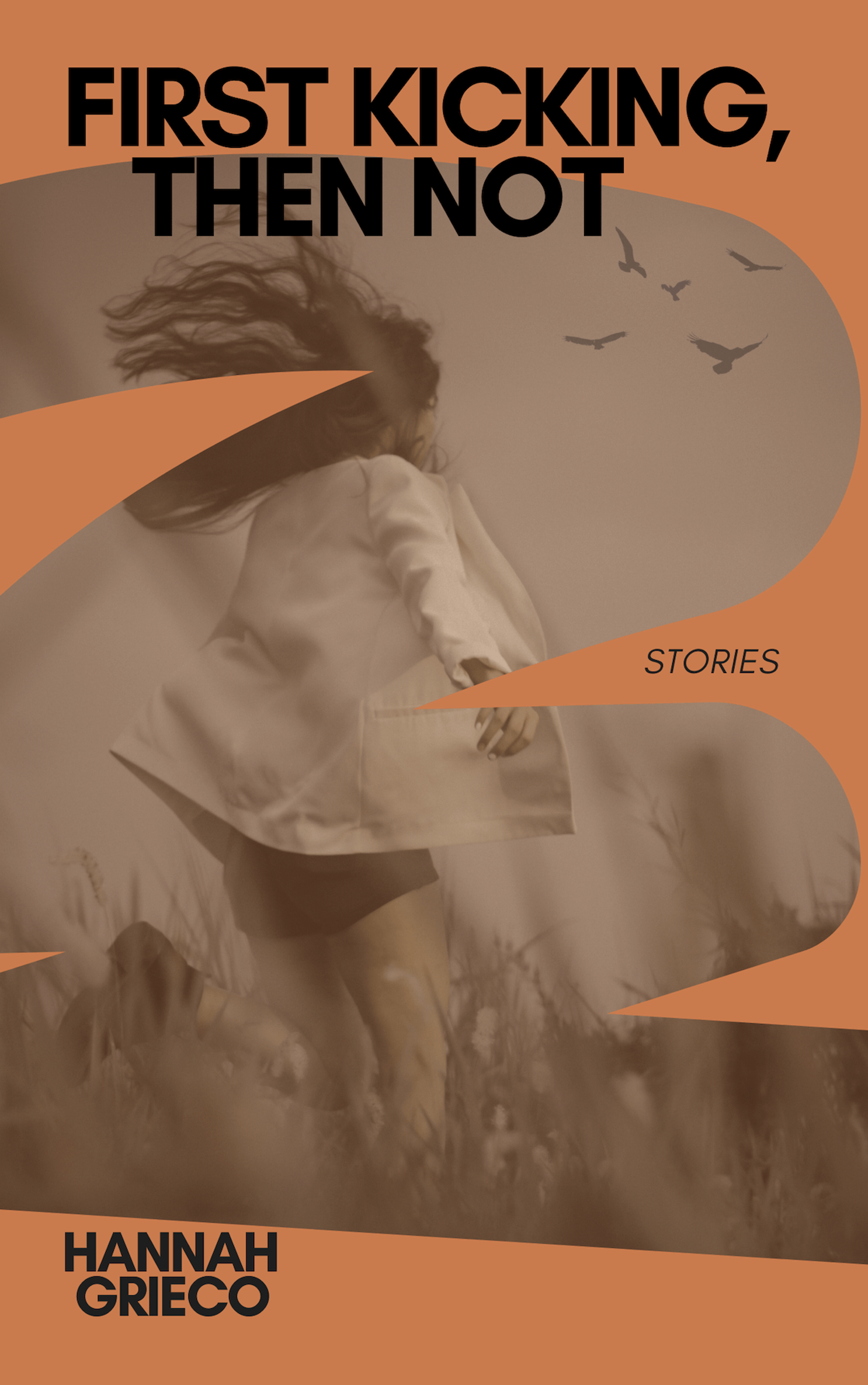
Blog Editor Chase Isbell interviews Shenandoah contributor Hannah Grieco about her book First Kicking, Then Not, a collection of short and flash fiction about motherhood and its discontents. Grieco speaks to flash fiction as a form and the ability of short prose to essentialize story into its most concentrated components. The pair spend most of the conversation discussing womanhood—especially how it feels to live as a woman. Through discussing her book, Grieco seeks to blow up stereotypes that romanticize motherhood’s docility and instead embraces its less desirable aspects, especially taboo and socially unacceptable feelings. Finally, Isbell and Grieco discuss bisexuality and sex, both in literature and in life. Her nonfiction piece “Thin Dreams” was published in Volume 73 Number 2.
The pieces in this collection, while short, are incredibly potent, as if deliberately resisting the dilution that might occur in longer writing. They appear as fiction concentrate, very much reminiscent of flash fiction. This formal commitment feels especially appropriate to me given that these stories are mostly about women whose emotions are minimized and repressed, often through overwhelming social pressures. Do you consider this book a collection of flash fiction? How are you thinking about the form of these very short short stories? Is their length informed by the themes of womanhood contained in them, as I tried to suggest?
I love flash prose. I love the distilled clarity and crispness of examining a life under a microscope. Maybe it’s because I’m a talker in real life, figuring out how I feel by speaking far too many words and sorting it all out after? But on the page, I can cut down to the bone. To the very reason I’m writing that story. What do I want to say? Why does this character exist? What question are they asking the world…or maybe what scream are they screaming at the sky?
It’s hard to scream and mean it if you’re saying too many words.
I love the way flash lingers in the mind, leaving us with questions and even alarm. Worry for the character. A moment where we recognize the nebulous nature of what an ending even is. On the page, in life, etc. With flash, the story isn’t really done, of course, but the moment is done. What happens next? That’s what we think about at night after we’ve turned off the lights but can’t sleep.
I don’t mean to write only women’s stories about women’s experiences. But I am a woman and I have a lot of screams in me. So this is what I’m writing. Women who have been hushed and contained and laughed at and diminished. But where does it all go? It’s still in them. They’re swollen with it. Ready to explode.
So yes, mostly flash in here. Even the longer stories are fractured narratives. Even my novel has this vibe!
That is part of why “To Rest Her Feet, To Feel Like One of the Girls” captured my attention so much. Out of all the short stories, this one really feels like the aesthetic touchstone of the book. It is a larger short story made up of smaller short stories—a kaleidoscope of perspectives that comment on a singular event, one flash of time in the lives of these characters. It feels very much like fiction about fiction, a story commenting on storytelling. Can you tell me more about the structure of this piece? How is it thinking about perspective, storytelling, and the narratives we give our own and each other’s lives?
This story was originally a fifteen-thousand-word start to a novel. But it wasn’t working. So I sat down and thought, again, about the why of the writing. What was I trying to do or say? I wanted to explore how women, particularly mothers, are controlled by the expectations of others. We are constantly judged and commented on and laughed at. We’re put on pedestals when we sacrifice our entire identity, but also mocked for losing ourselves, and also derided if we don’t, and also and also and also—
Mothers are supposed to be nonsexual. Barely human. Saints, but quiet about it.
To hell with it. Every mother I know has dreamed about abandoning her kids. She’s just afraid to even whisper such a thing because of the inevitable avalanche.
The different characters in this story, even the kind ones, are me exploring this theme. It’s incredibly cathartic to write something that you’re afraid to do or say in real life. And writing this stuff makes it easier to do or say scary things in real life too.
The titular story, “First Kicking, Then Not,” is my favorite in the collection, and I was happy it came first. A strange story about a bird of prey abducting children in a small town, the horrors of the events of the narrative are contrasted, or perhaps complemented, by the understated narration of the speaker and the simple, straightforward language. How did you come up with the idea for this story? And why did you decide to borrow its title for the name of the collection? Should readers be thinking of it as, in some way, defining this book as a whole?
This was my first real attempt at literary horror. I just wanted to write a scary story about a giant bird monster that kidnapped kids! But a story tends to write itself. So what came out was a piece about a young woman who is too much for her small town. Too much for her family. Always just too much. And every time she comes close to accepting herself, to allowing herself to simply be who she is, something horrible and nightmarish happens. The people she loves suffer terribly. No matter how good she is, how much she tries to do what’s expected—the second she returns to her authentic self, the bird appears. I guess that’s the real horror story, it turns out.
It starts the book because it is the book.
An examination of womanhood is at the center of this book, as I mentioned during my first question. Motherhood in particular comes up again and again in these stories, documenting often its most humiliating, dehumanizing, disappointing, and maddening aspects. However, I want to emphasize that at the same time there are moments of genuine connection and humanity, and a sincere longing to be with others defines these women’s lives, no matter how miserable. Can you walk me through this book’s feminism? How is it thinking about the conditions of living as a woman?
This has a short and easy answer. Mothers are complicated human beings with only one thing in common: they take care of children. I can be profoundly in love with my children and also experience a lifetime of feelings that aren’t Hallmark-worthy. Hallmark can fuck off in a giant scream into the sky. Save your cards and flowers and let me exist as a messed-up human being.
I guess I’m a feminist. But I’m way past that word. I’m a frothing beast who just turned fifty. I’m done with society’s nonsense, you know?
“Fish” especially was a cathartic reading experience for me. In a culture that, in my opinion, continues to mostly repress the pain of lockdown and now wholesale ignores the continuation of the pandemic and the ongoing spread of COVID-19, to see an honest portrayal of Covid-induced isolation, overwhelm, helplessness, and insanity was heartening and resonated with me deeply. Reading “Fish” made me wonder when these short stories were written. And do you think of this book as being informed, or even commenting on, the post-Covid era?
These stories were written between 2019 and 2025. So the COVID-19 pandemic began right in the middle! And that particular story was a cry for help. In fact, it was initially accepted at Litro as an essay! I tried to explain that it was fiction, and the editor said, “No, no. It’s REAL.”
It did end up published as a short story, but I’ll never forget that. I don’t think I’ll ever write anything, ever again, that isn’t informed by the COVID-19 experience somehow. That time changed, and continues to change, all of us. I’m a college professor and I see this in my students every single day.
Relatedly, this book is interested in mental health and its pathologization, medicalization, and treatment, especially as it manifests in our social lives and relationships to others. Medications like Zoloft, Lithium, and Lexapro shape the psychological landscape of story and character alike as this book considers what it means to be a “healthy,” well-adjusted person. How is this book thinking about mental health in contemporary social life?
I frequently write about mental illness and neurodivergence because I live with these things. What is well-adjusted? A made-up thing? I’m so bored by neurotypical narratives. And to me, “healthy” is very difficult to define. Instead, let’s explore joy. Let’s open locked doors. Let’s find identity outside of the good girls we were trained to be. Our mothers were miserable. Let’s not do that, okay?
Sex is another major theme of this collection and another site for exploring characters and their interpersonal lives. The sexuality of this book read as bisexual to me. Yes, in the sense that some characters might literally think of themselves as bisexual and have sexual relationships with both men and women. But I am also thinking beyond just the particular sexual orientation or identity of these characters and toward how they form relationships more broadly. This book thinks about sex often through triangulation. A character might have ambivalent desires about their past and their present, their own individuality and the relationships that define them, and of course between the men and women in their lives. These women are often stuck between the things they want, on top of often navigating commitments across multiple genders—commitments that are, if not exactly erotic, certainly emotionally charged and intimate. How is this book thinking about sexuality? Is there something to reading this book through a lens of bisexuality, or am I doing a bit of vulgar Freudianism and revealing more about myself than I am your book?
Oh no, this book is absolutely bisexual! No vulgar Freudianism on your part!
I am bisexual, and I love to write about sex. Often with women! My husband is a great sport about all the affairs I have on the page. This is another simple and easy answer, honestly. I want more people to write about sex outside the romance genre. We’re constantly told not to do that. But as I’ve made clear, I don’t like being told what to do. I love to read about sex, write about sex, have sex. Writing rules are stupid, and we should all just break them constantly.
Sex is about communication and expression and finding joy. We can’t reach for these things when we’re confined by expectation. Being told to avoid writing “too graphically” is an extension of this. Not letting characters have sex is just another method of controlling women. We aren’t supposed to be sexual unless we’re in someone’s fantasy, I guess? In the romance genre, only? I love reading romance, but nah.
I’m married to a man. I have three kids. I drive a minivan, for Christ’s sake! Let me write about sex because it matters to me, and to these women on the page. Let them be sexual, let them be deviants, let them run off with that hot masc from the gym. Let them live on the page.
Books should be human. What’s more human than fucking?