Comics

Robert Morris Story

by Joel Holub
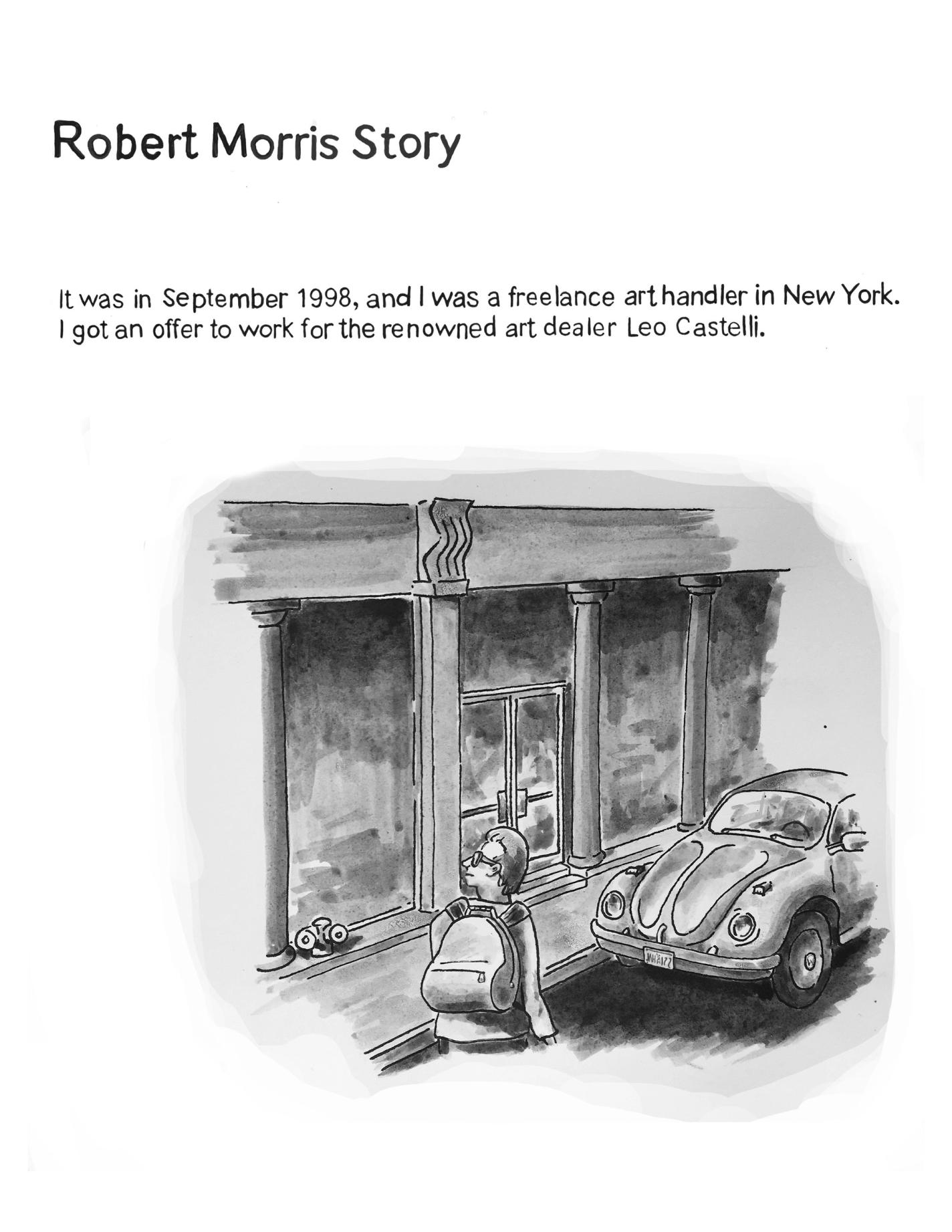
A 21-page grayscale comic titled “Robert Morris Story.” Each page has blank white space as the background. Page 1: The title is at the top of the page. The text beneath reads, “It was in September 1998, and I was a freelance art handler in New York. I got an offer to work for the renowned art dealer Leo Castelli.” On the lower half of the page, a man with a backpack stands outside a building with columns, looking toward the entrance. A car is parked at the curb.
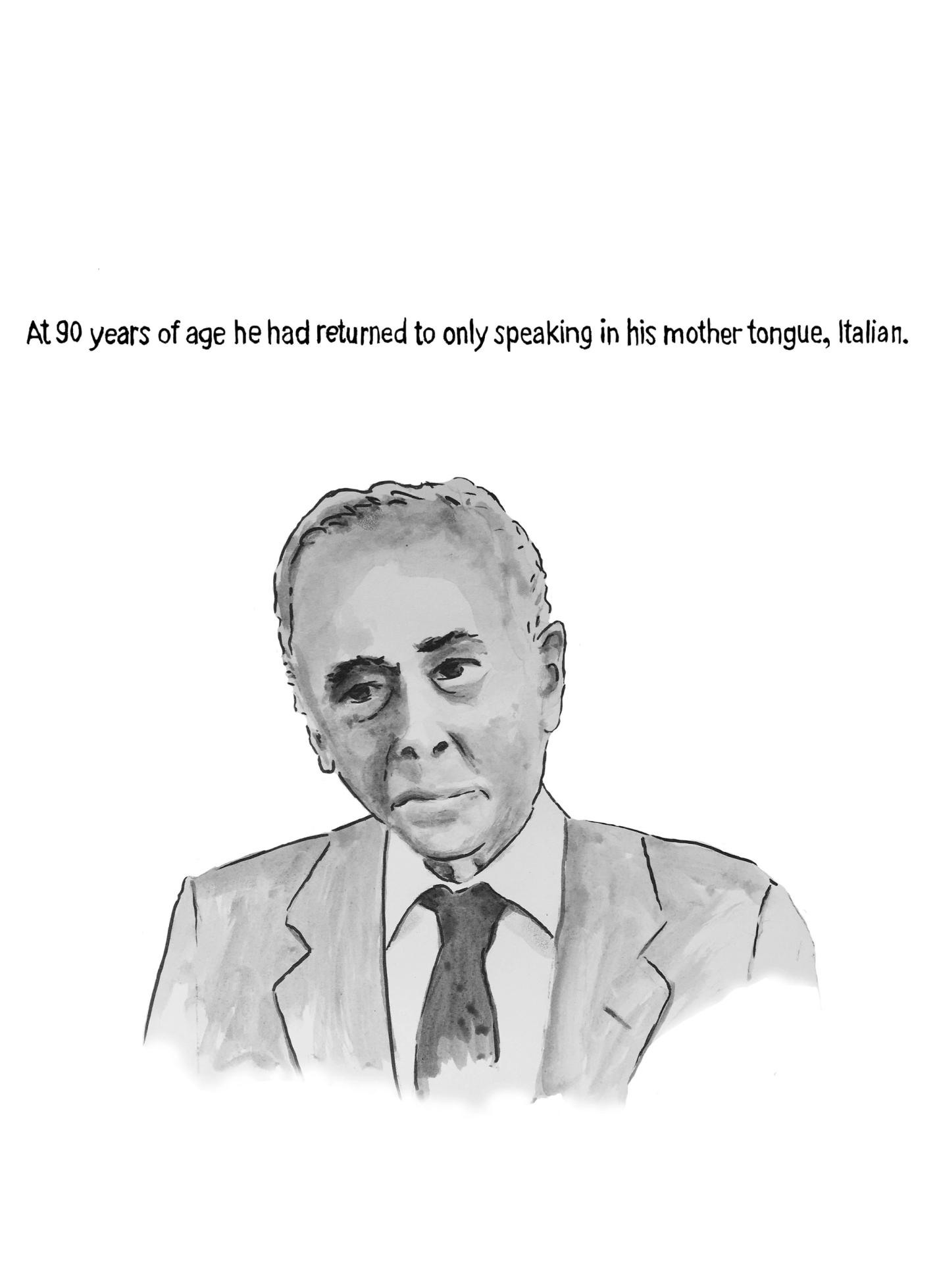
Page 2: A close-up portrait of an elderly man in a suit and tie. He looks slightly downward with a slight frown. The text above reads, “At 90 years of age he had returned to only speaking in his mother tongue, Italian.”
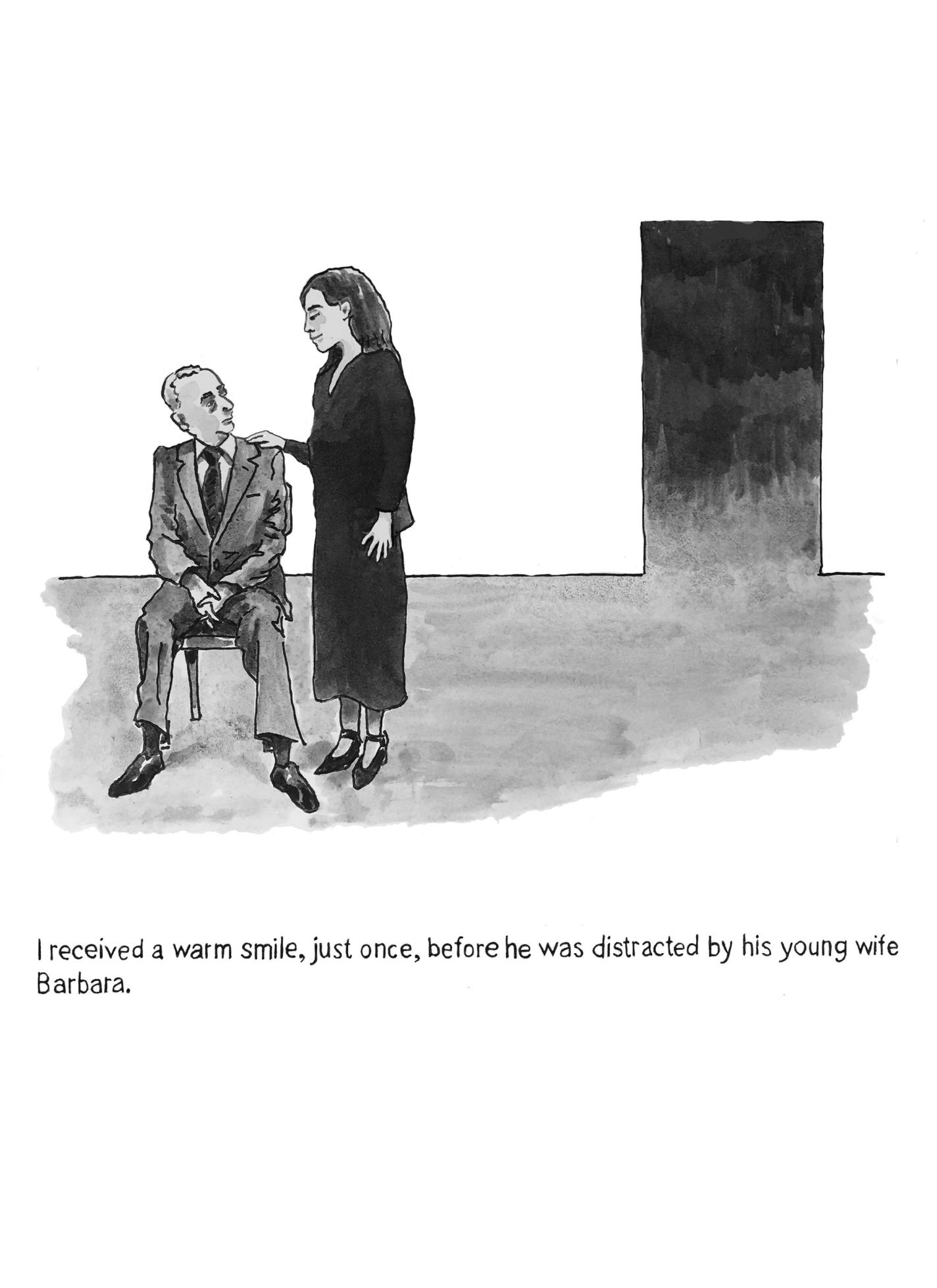
Page 3: The man is sitting in a chair while a woman in a dress stands beside him, resting a hand on his shoulder. There is a dark rectangular wall shape behind them on the right side. The text beneath them reads, “I received a warm smile, just once, before he was distracted by his young wife Barbara.”
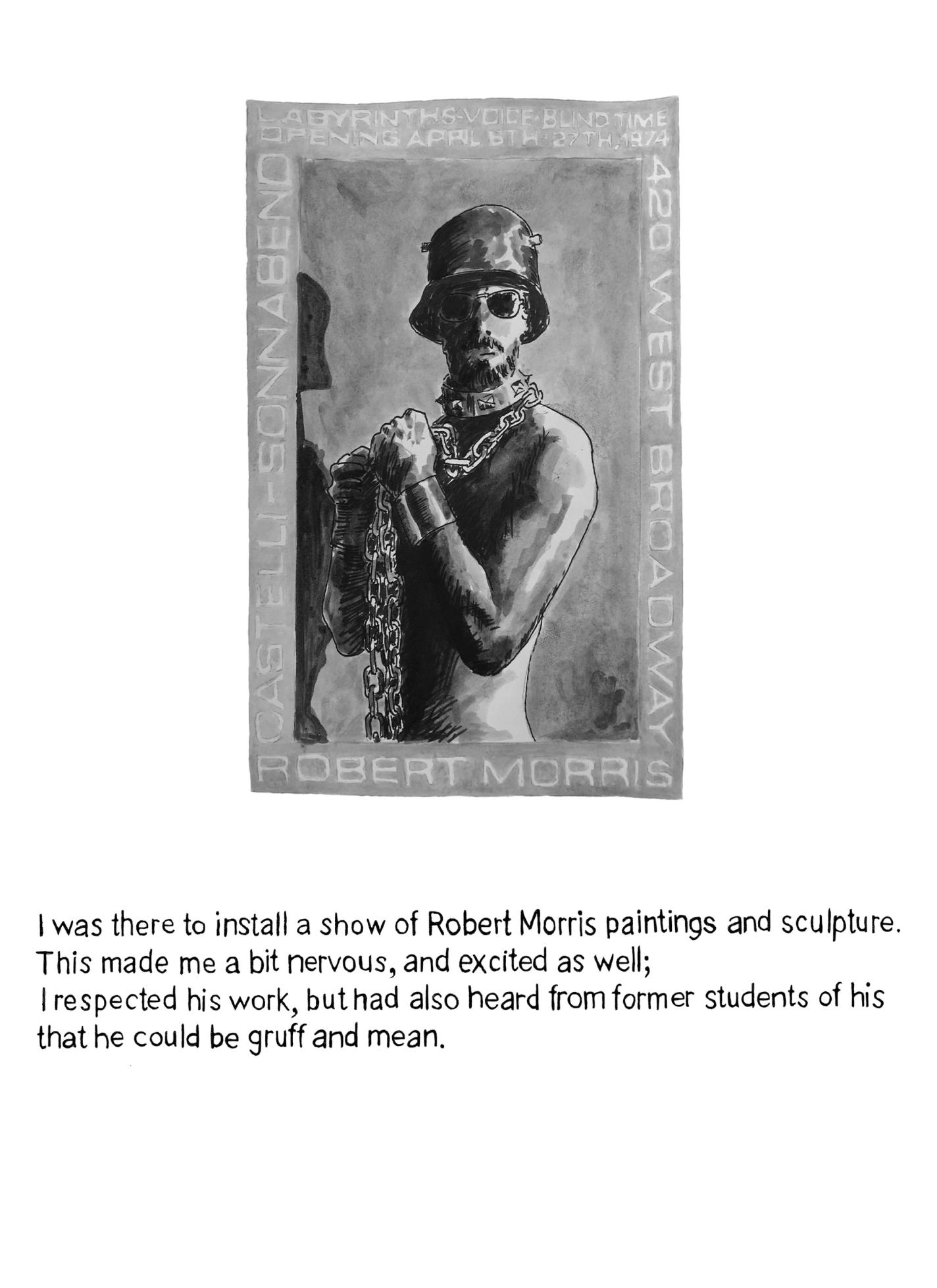
Page 4: A poster with a shirtless man wearing sunglasses and a mental helmet, holding thick chains draped around his neck. The frame of the poster includes carved text with a gallery address, an opening date, and the name “Robert Morris.” Beneath the image, the text reads, “I was there to install a show of Robert Morris paintings and sculpture. This made me a bit nervous, and excited as well; I respected his work, but had also heard from former students of his that he could be gruff and mean.”
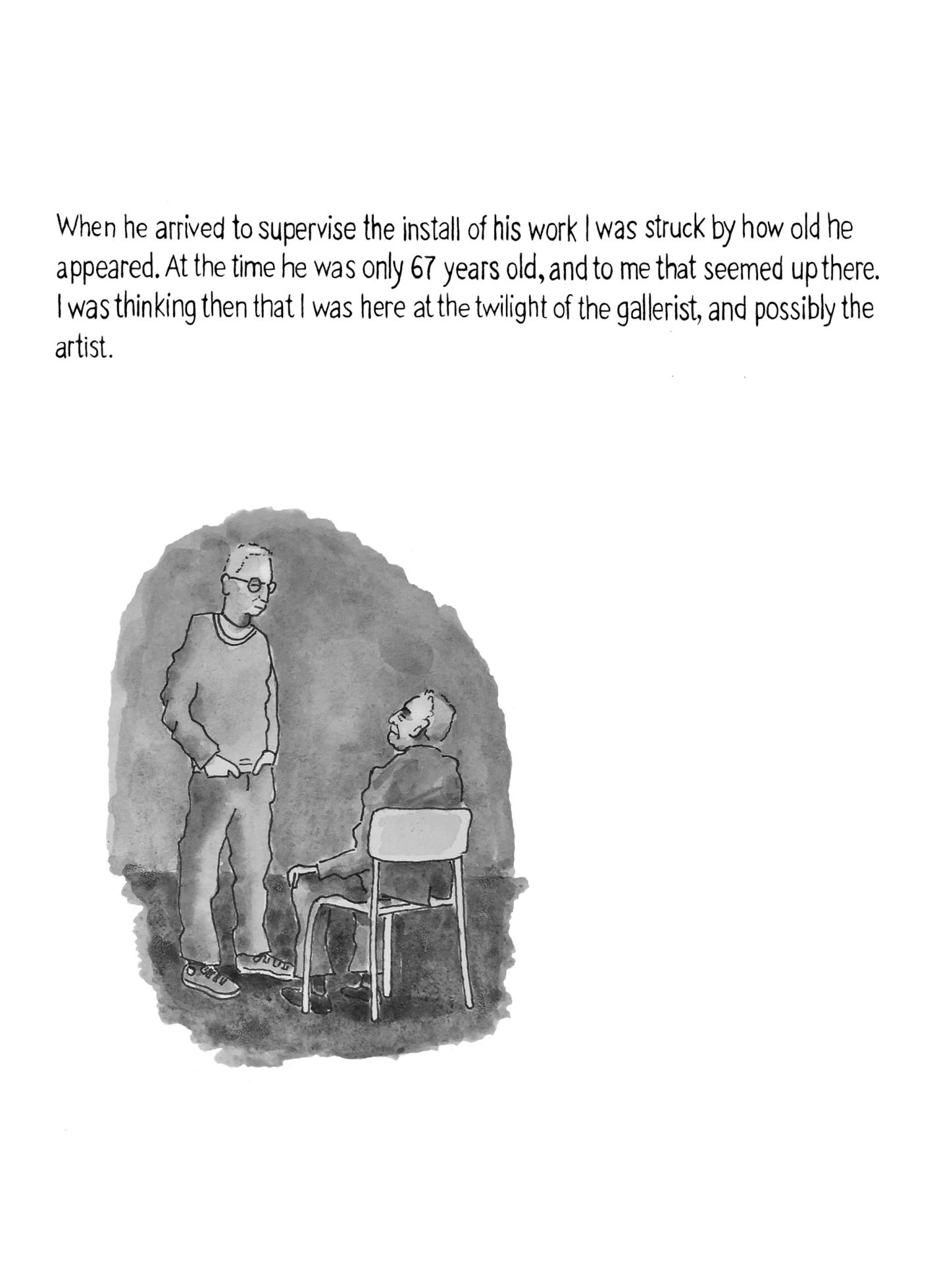
Page 5: An older man is standing with his hands in his pockets while the man in a suit sits in a chair looking up at him. The text below reads, “When he arrived to supervise the install of his work I was struck by how old he appeared. At the time he was only 67 years old, and to me that seemed up there. I was thinking then that I was here at the twilight of the gallerist, and possibly the artist.”
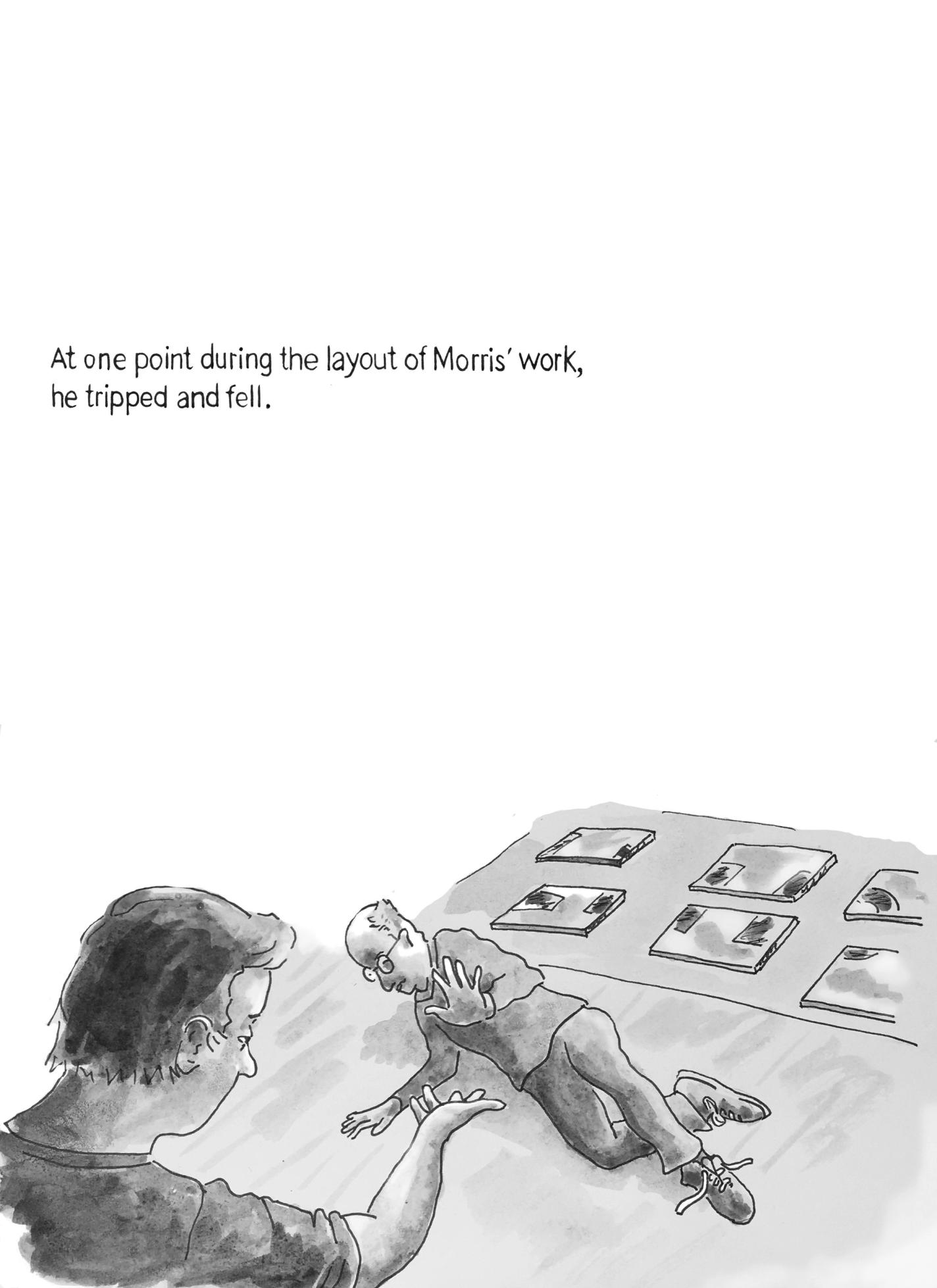
Page 6: A man with glasses is on the ground with his arm out. Several artworks are laid out on the floor behind him. Another man reaches toward him. The text above reads, “At one point during the layout of Morris’ work, he tripped and fell.”
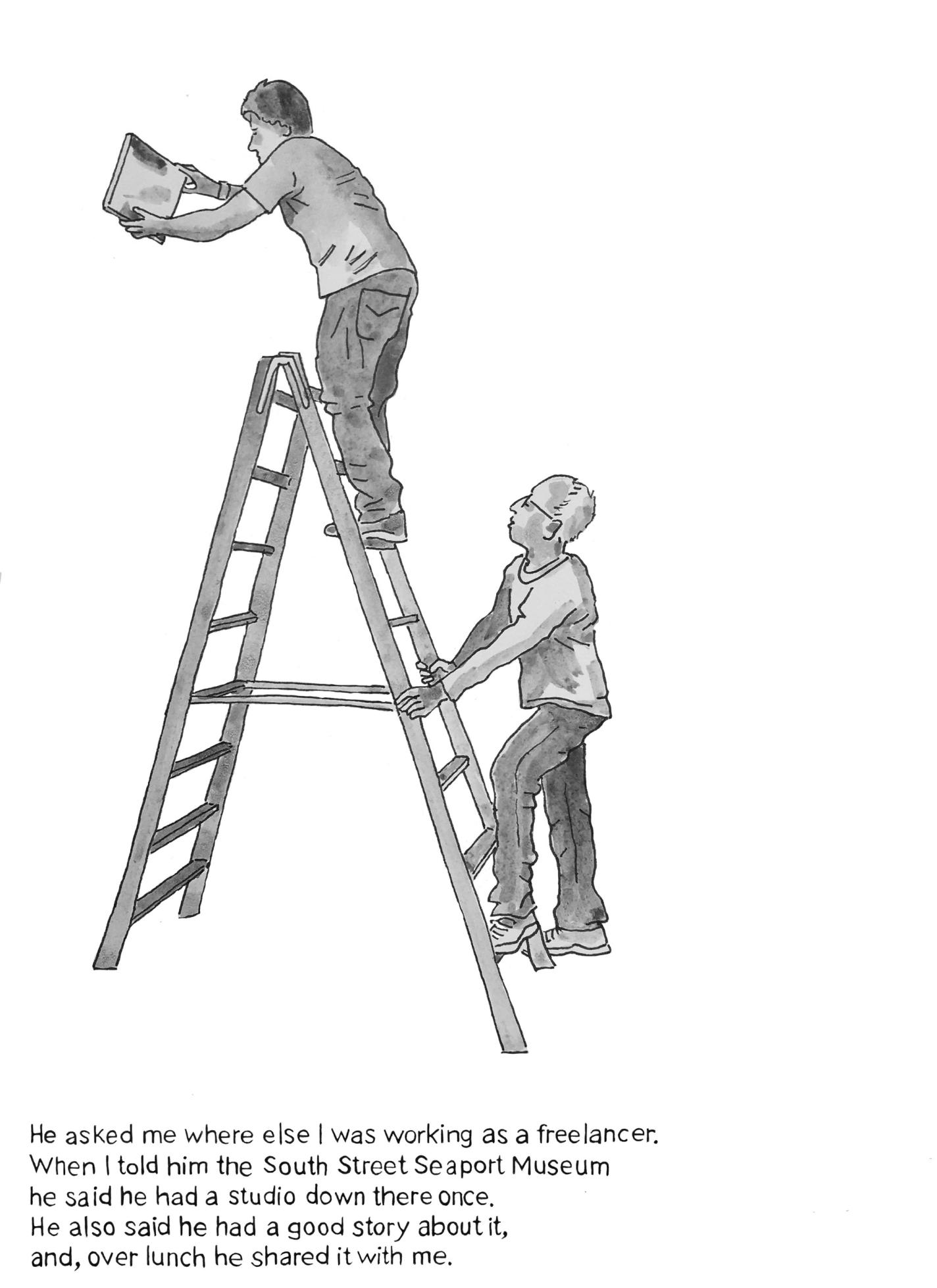
Page 7: Two men are on a ladder. One man stands high on the steps holding an object while the other, wearing glasses, steadies the ladder from below. The text below reads, “He asked me where else I was working as a freelancer. When I told him the South Street Seaport Museum he said he had a studio down there once. He also said he had a good story about it, and, over lunch he shared it with me.” The comic shifts from blank white space to dark tones for its background.
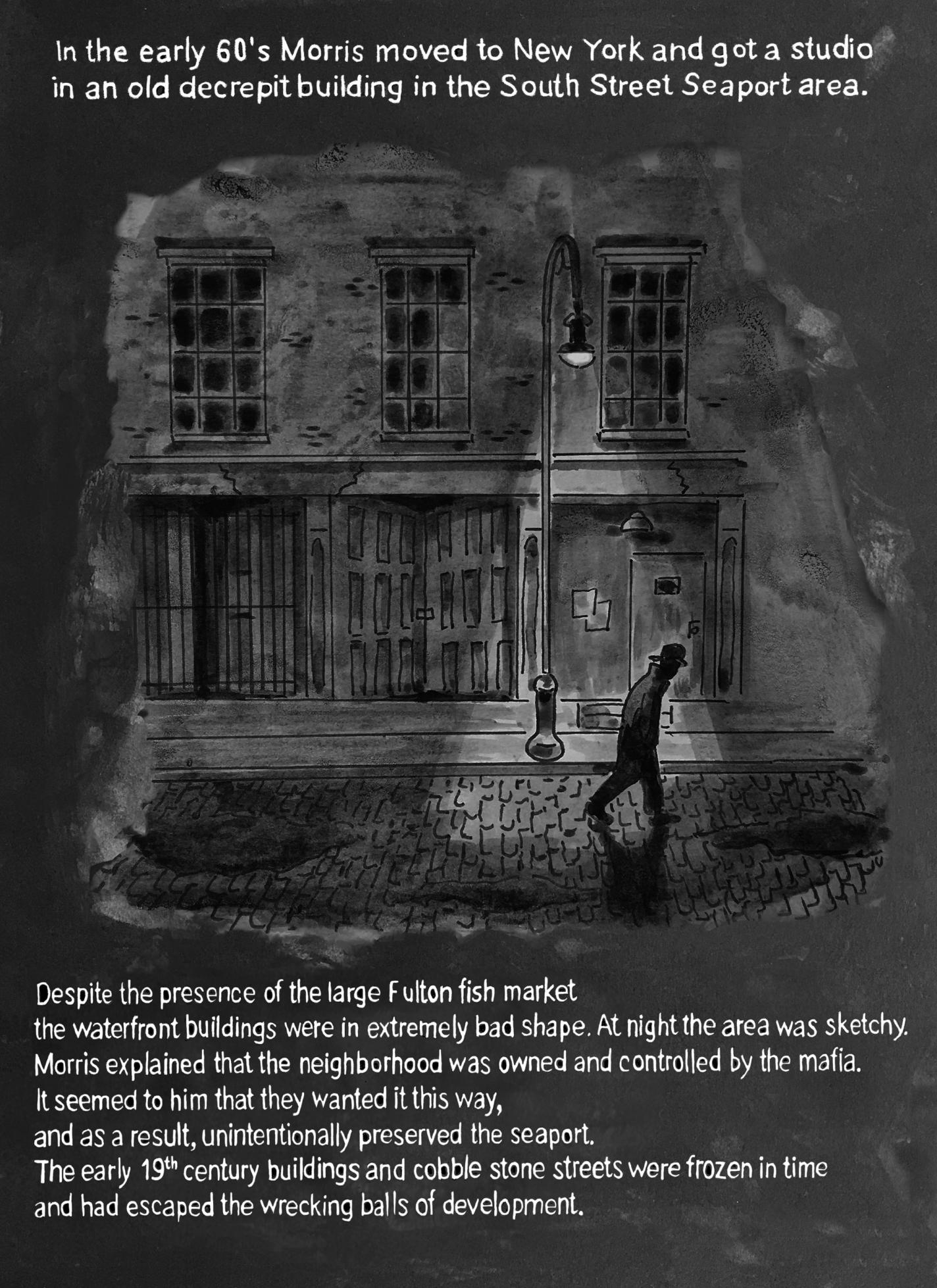
Page 8: There is an old, crumbling building at night. A streetlamp casts a long beam of light over cobblestones as a man in a hat walks past. The upper text reads, “In the early 60’s Morris moved to New York and got a studio in an old decrepit building in the South Street Seaport area.” The text beneath the image reads, “Despite the presence of the large Fulton fish market, the waterfront buildings were in extremely bad shape. At night the area was sketchy. Morris explained that the neighborhood was owned and controlled by the mafia. It seemed to him that they wanted it this way, and as a result, unintentionally preserved the seaport. The early 19th century buildings and cobble stone streets were frozen in time and had escaped the wrecking balls of development.”
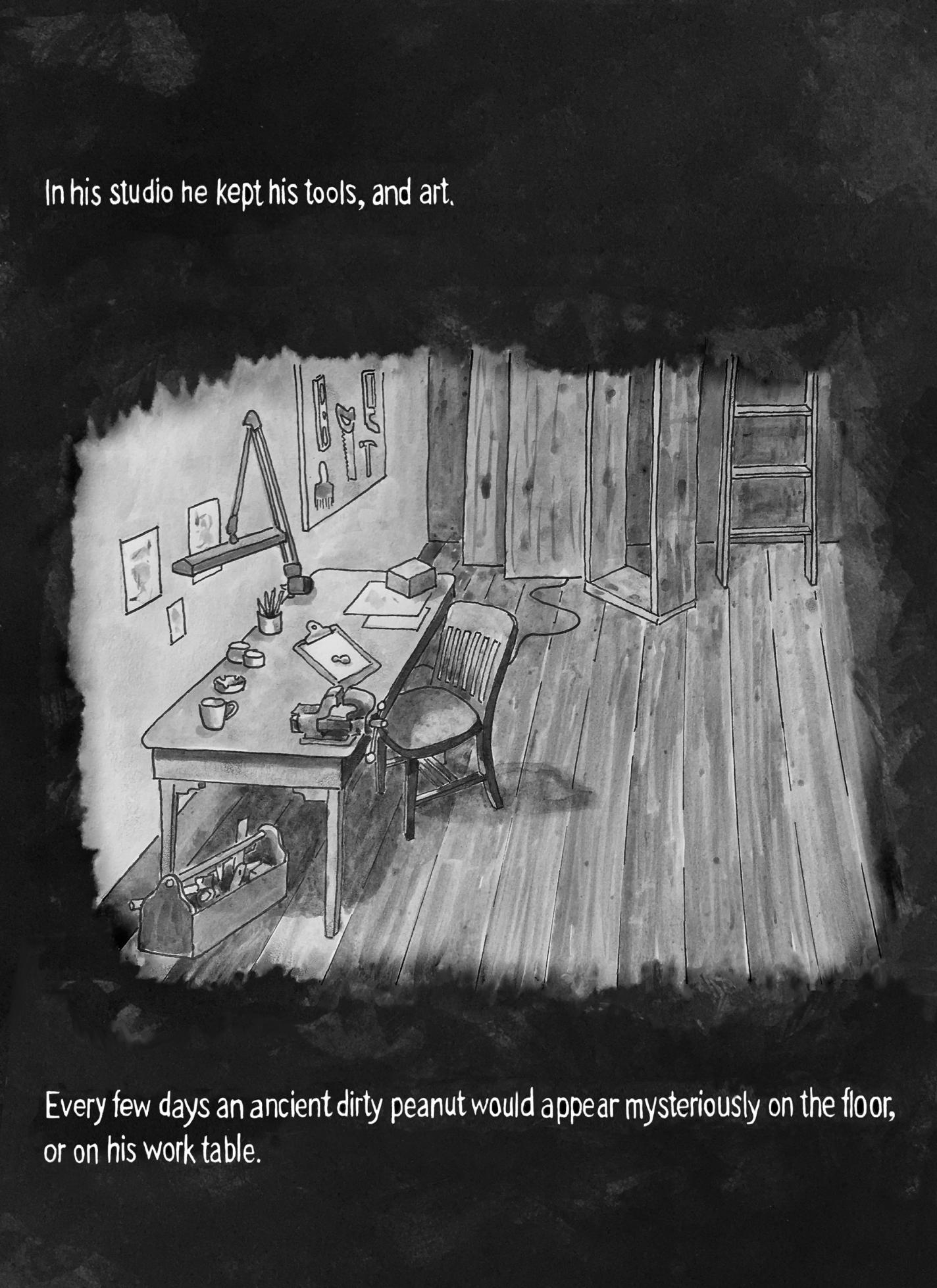
Page 9: There is a small room with a wooden desk covered with tools, papers, cups, and small objects. A chair sits pushed toward the desk, and a toolbox rests on the floor beneath it. Drawings hang on the wall, and there’s a ladder in the corner. The text above reads, “In his studio he kept his tools, and art.” The text on the bottom reads, “Every few days an ancient dirty peanut would appear mysteriously on the floor, or on his work table.”
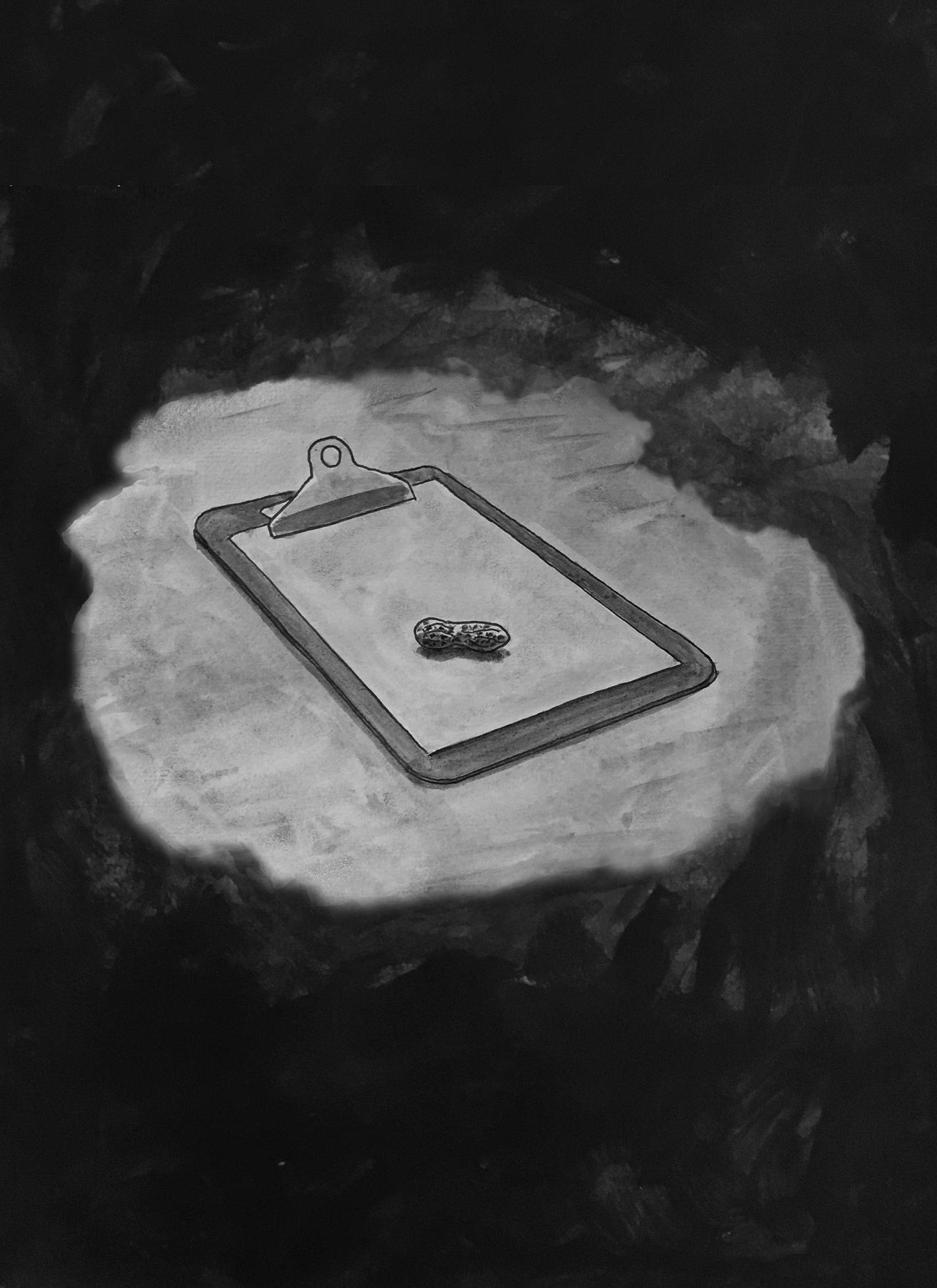
Page 10: There is a clipboard on a table. An old peanut is at the center of the clipboard.
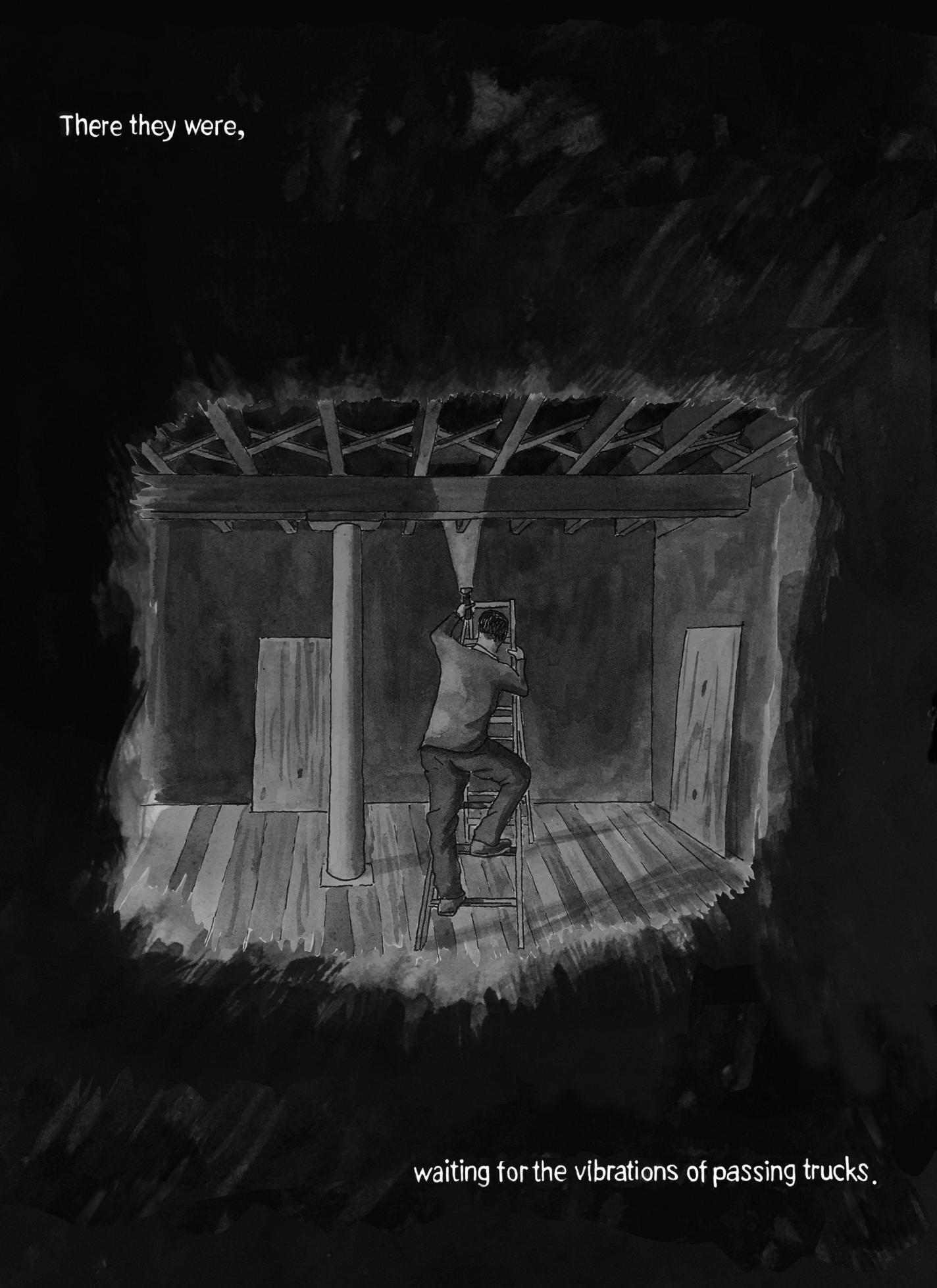
Page 11: A man is standing on a ladder inside a room, holding a flashlight and reaching up toward exposed ceiling beams. The top text reads, “There they were,” and at the bottom, “waiting for the vibrations of passing trucks.”
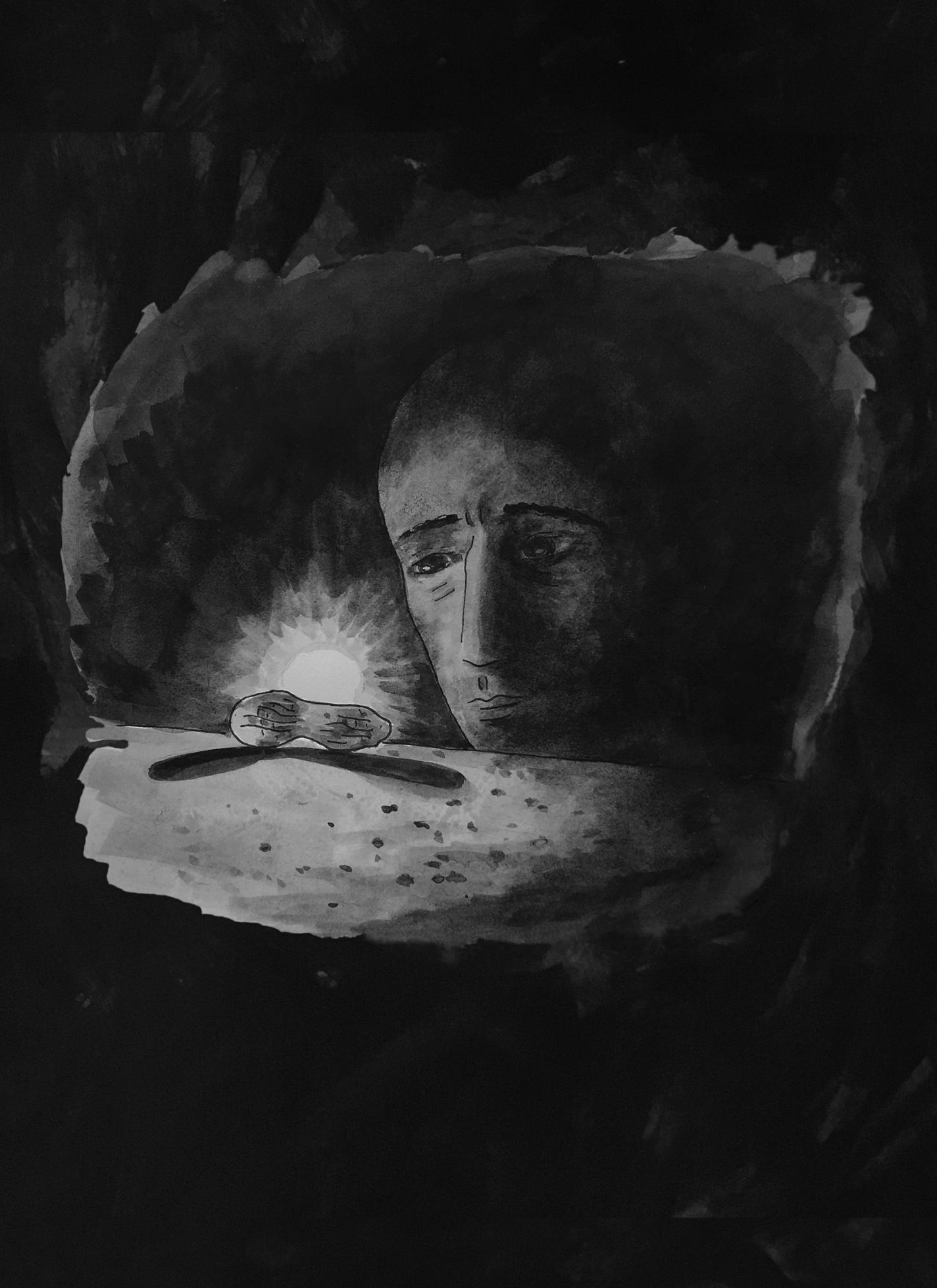
Page 12: A man’s face is illuminated by a small glowing light shining directly onto a peanut lying on a flat surface. The man’s face is solemn.
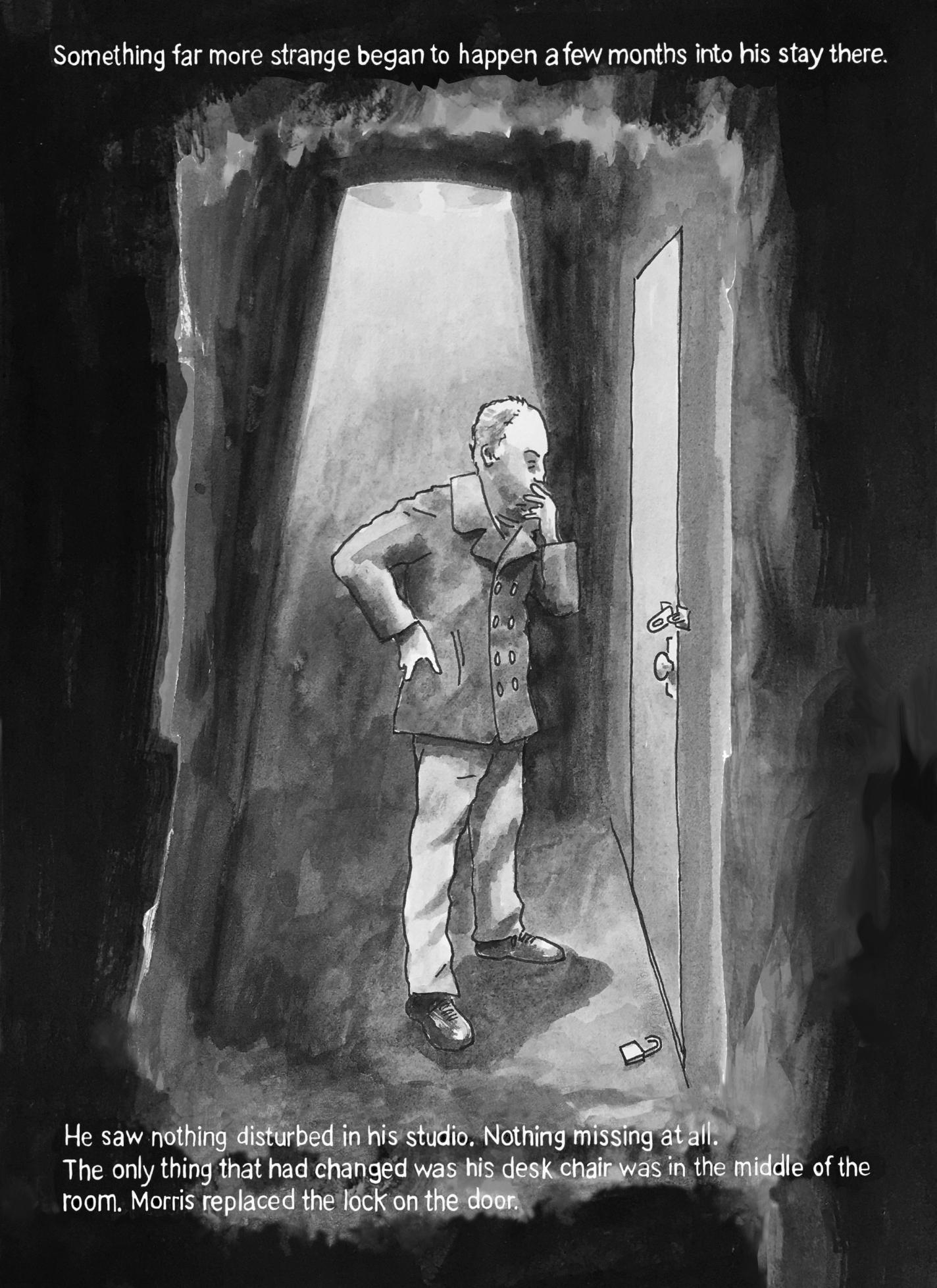
Page 13: A man is standing outside a door, leaning forward with one hand on his chin, with light beaming down from above. The lock to the door is broken and on the floor. The text at the top reads, “Something far more strange began to happen a few months into his stay there.” The bottom text reads, “He saw nothing disturbed in his studio. Nothing missing at all. The only thing that had changed was his desk chair was in the middle of the room. Morris replaced the lock on the door.”
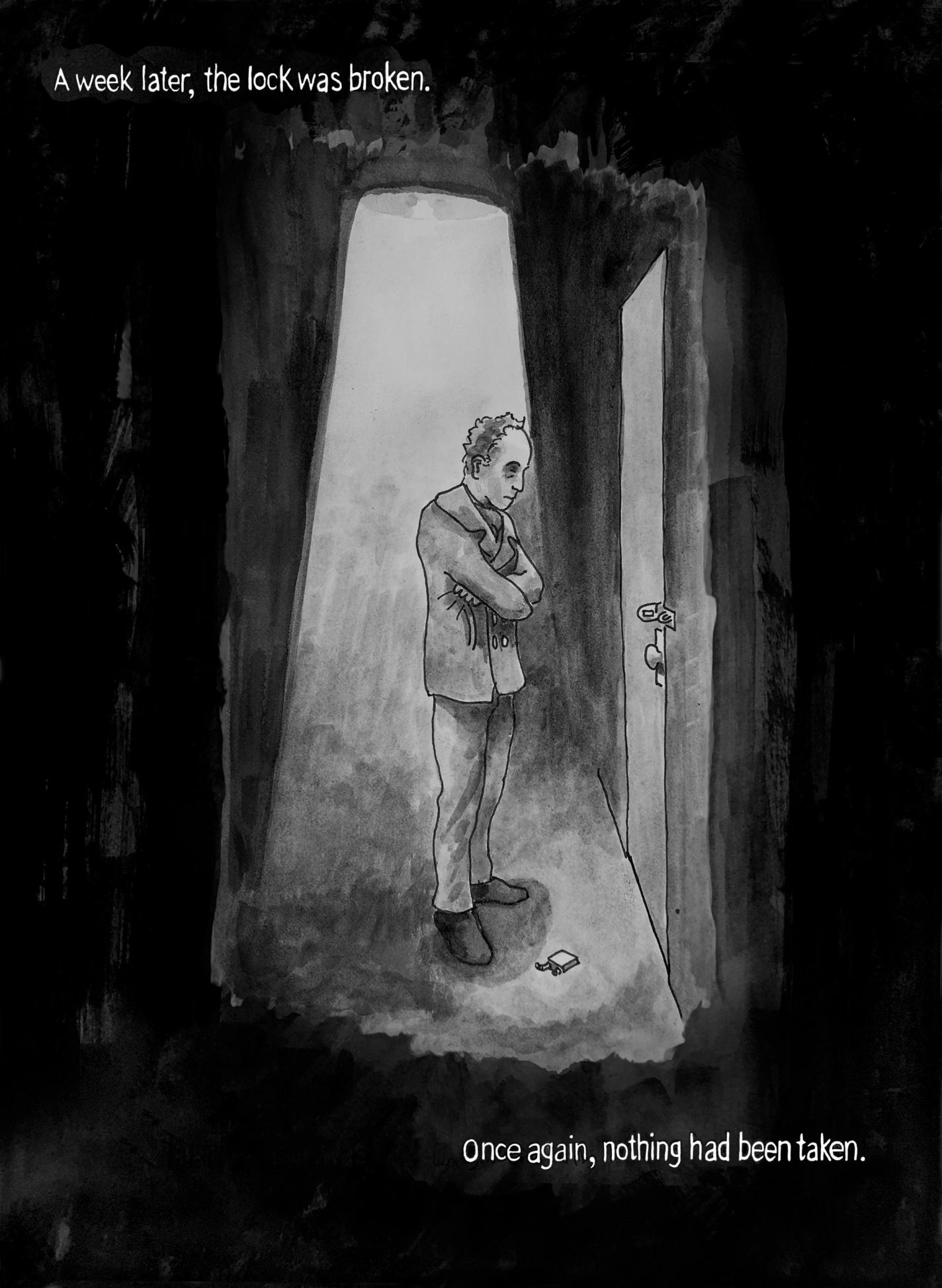
Page 14: The man is looking at the door with the lock broken and on the floor, with light beaming down from above. The top text reads, “A week later, the lock was broken.” At the bottom, “Once again, nothing had been taken.”
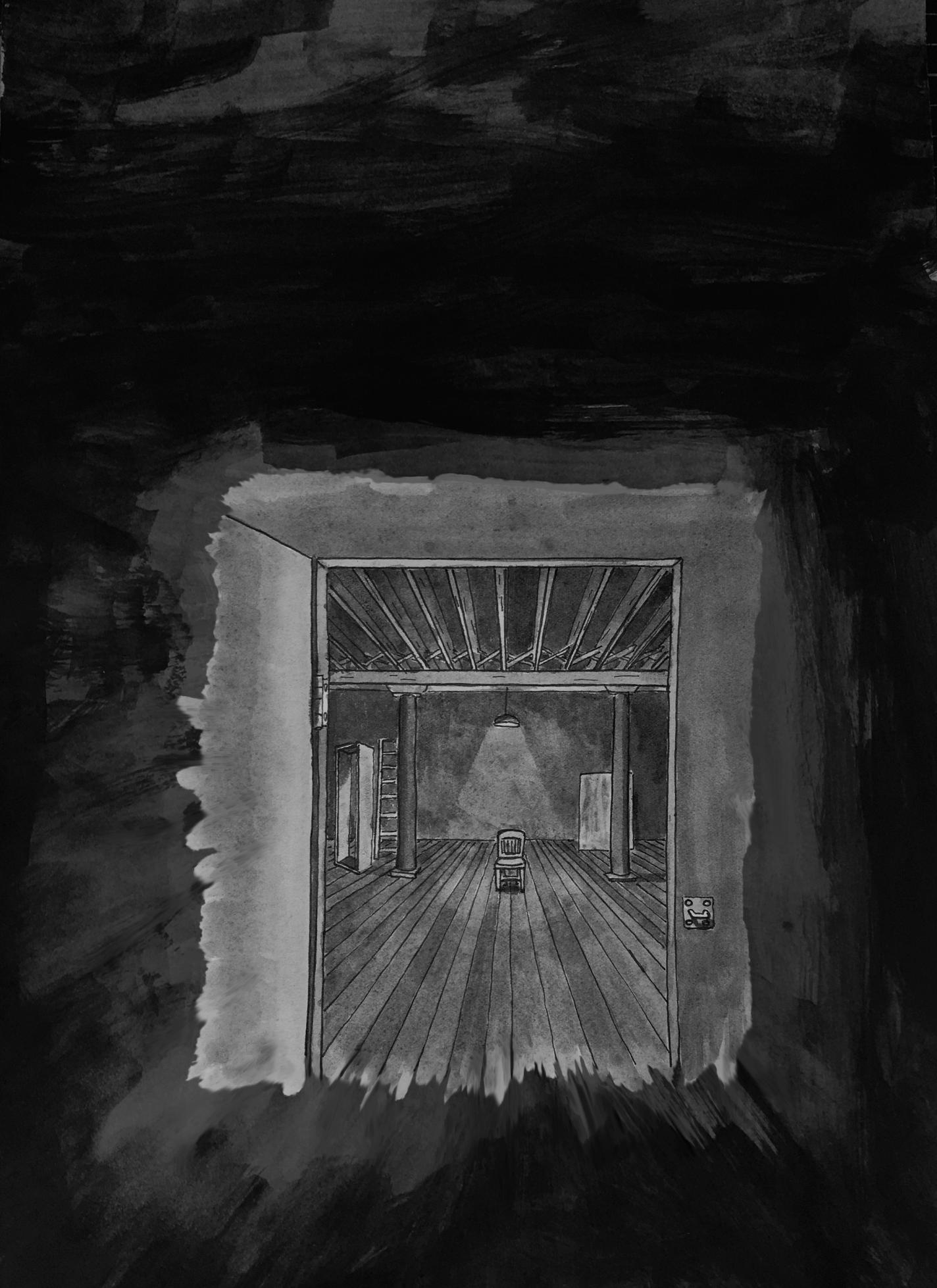
Page 15: From a perspective just outside the doorframe, there is an empty room with exposed ceiling beams, a ladder, a wooden frame, a wooden board, and a single wooden chair placed under a hanging lamp in the center.
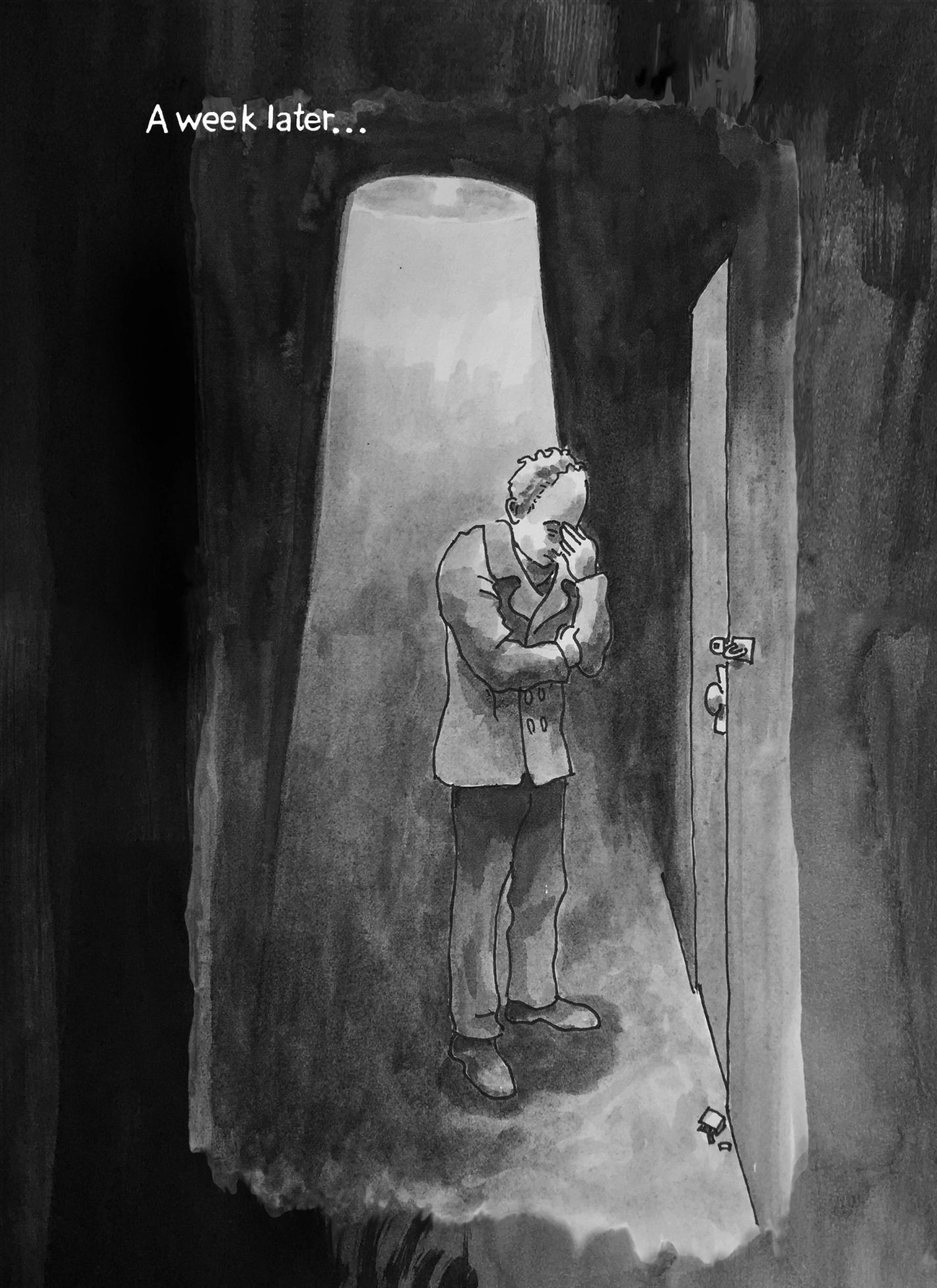
Page 16: The man is standing in front of the door, with light beaming down from above. One hand is on his forehead in the direction of the door, and a broken lock. The top text reads, “A week later…”
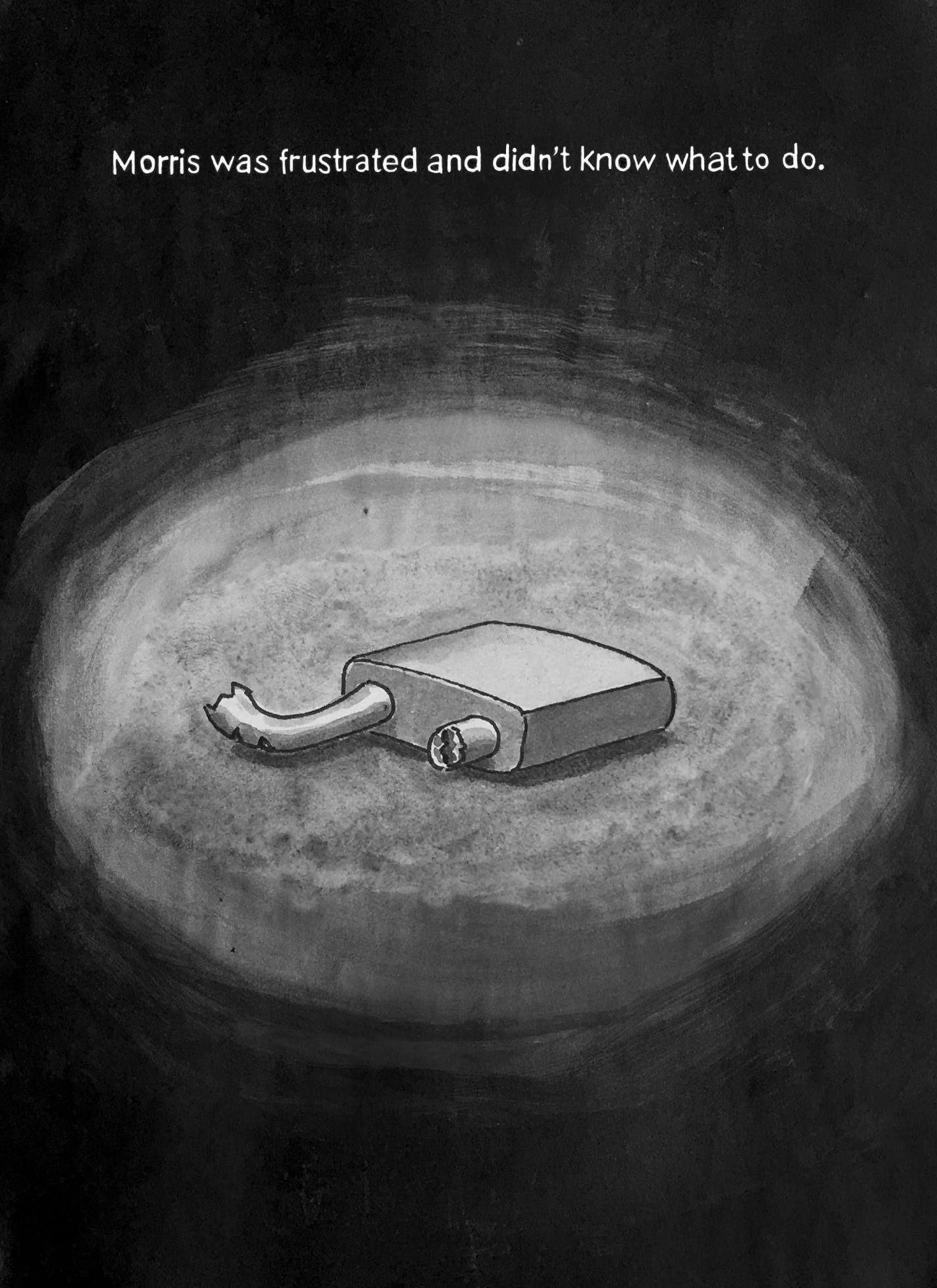
Page 17: A broken lock is on the ground. Above it, the text reads, “Morris was frustrated and didn’t know what to do.”
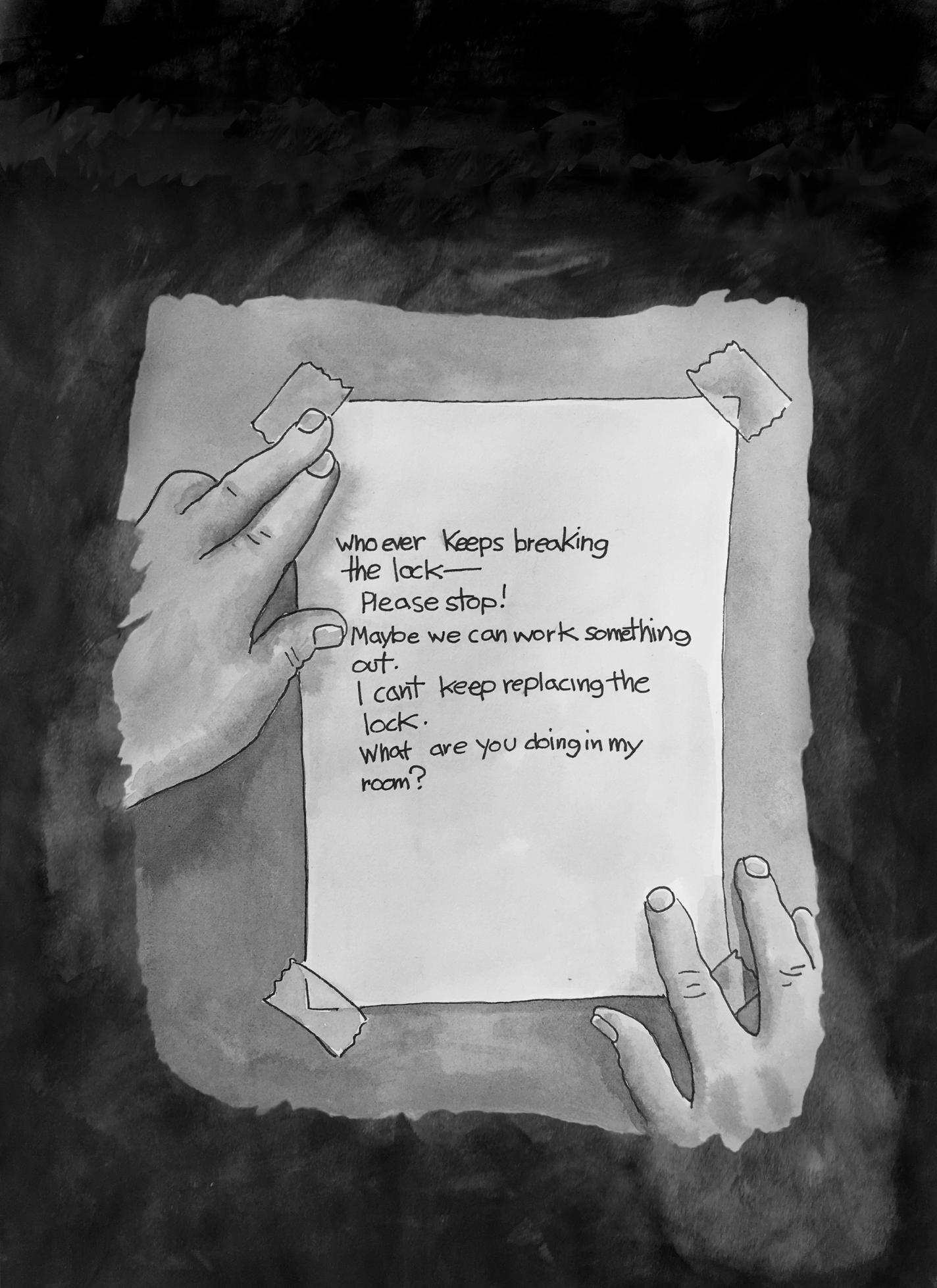
Page 18: Two hands are against the top left and bottom right corners of a paper taped to a wall by all four corners. The paper reads, “whoever keeps breaking the lock—Please stop! Maybe we can work something out. I can’t keep replacing the lock. What are you doing in my room?”
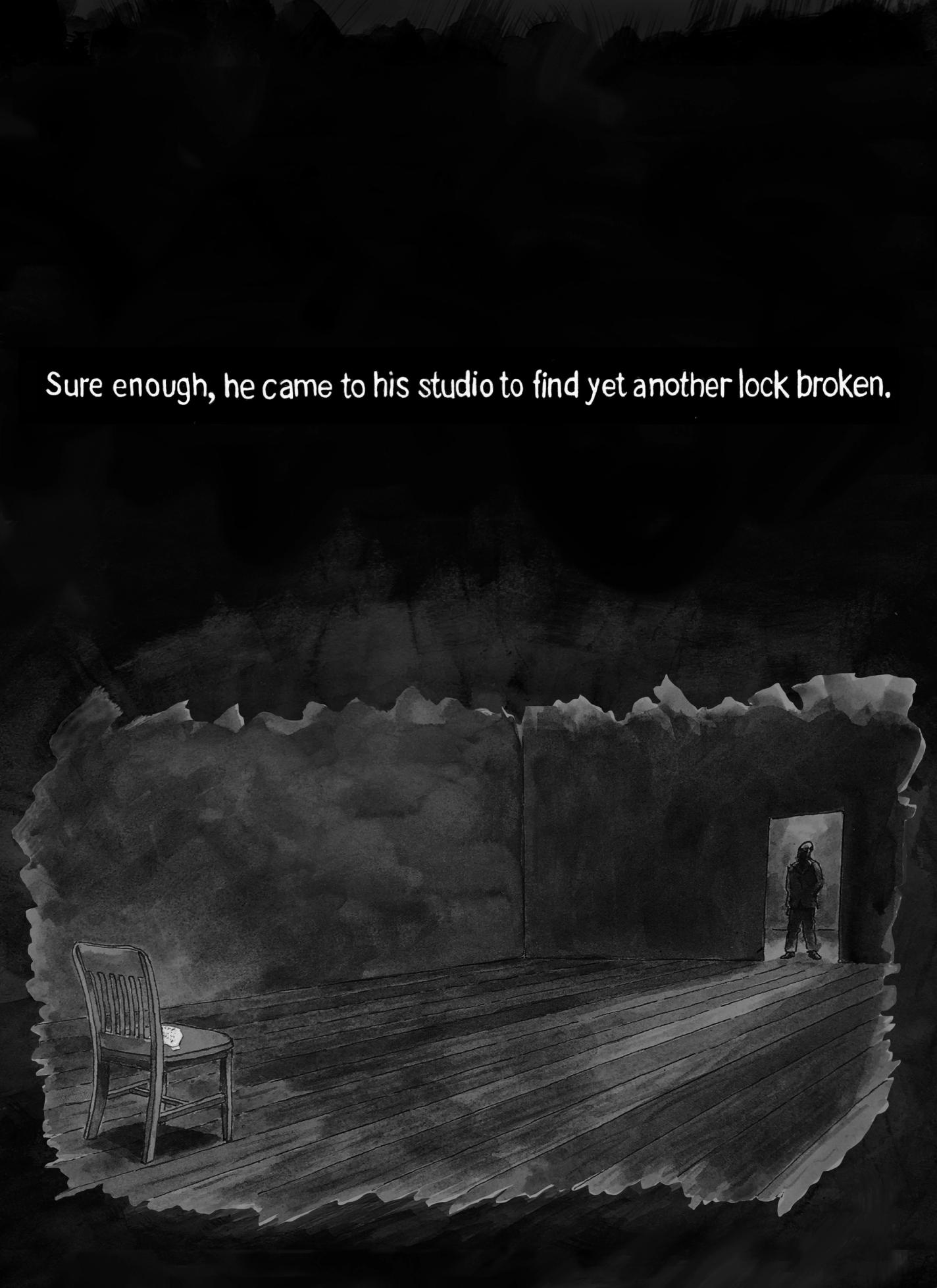
Page 19: A man is standing at the doorway entrance to a room. The room is long and empty with a single wooden chair on the far side of the room. There is a white note on the chair. The text at the top reads, “Sure enough, he came to his studio to find yet another lock broken.”
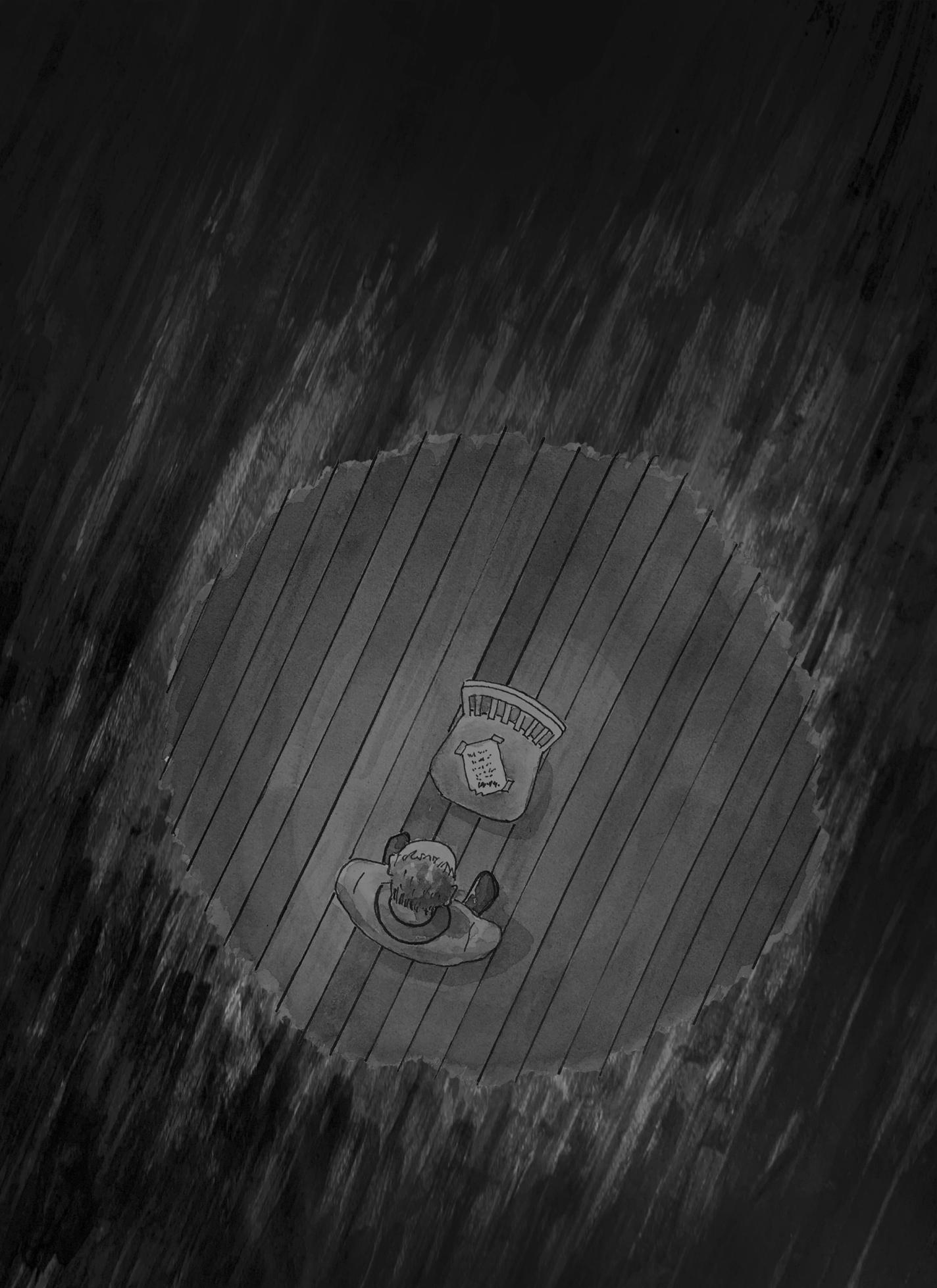
Page 20: From an overhead view, the man is looking down at the chair in the middle of the room. In front of the man, the note is on the seat of the chair.
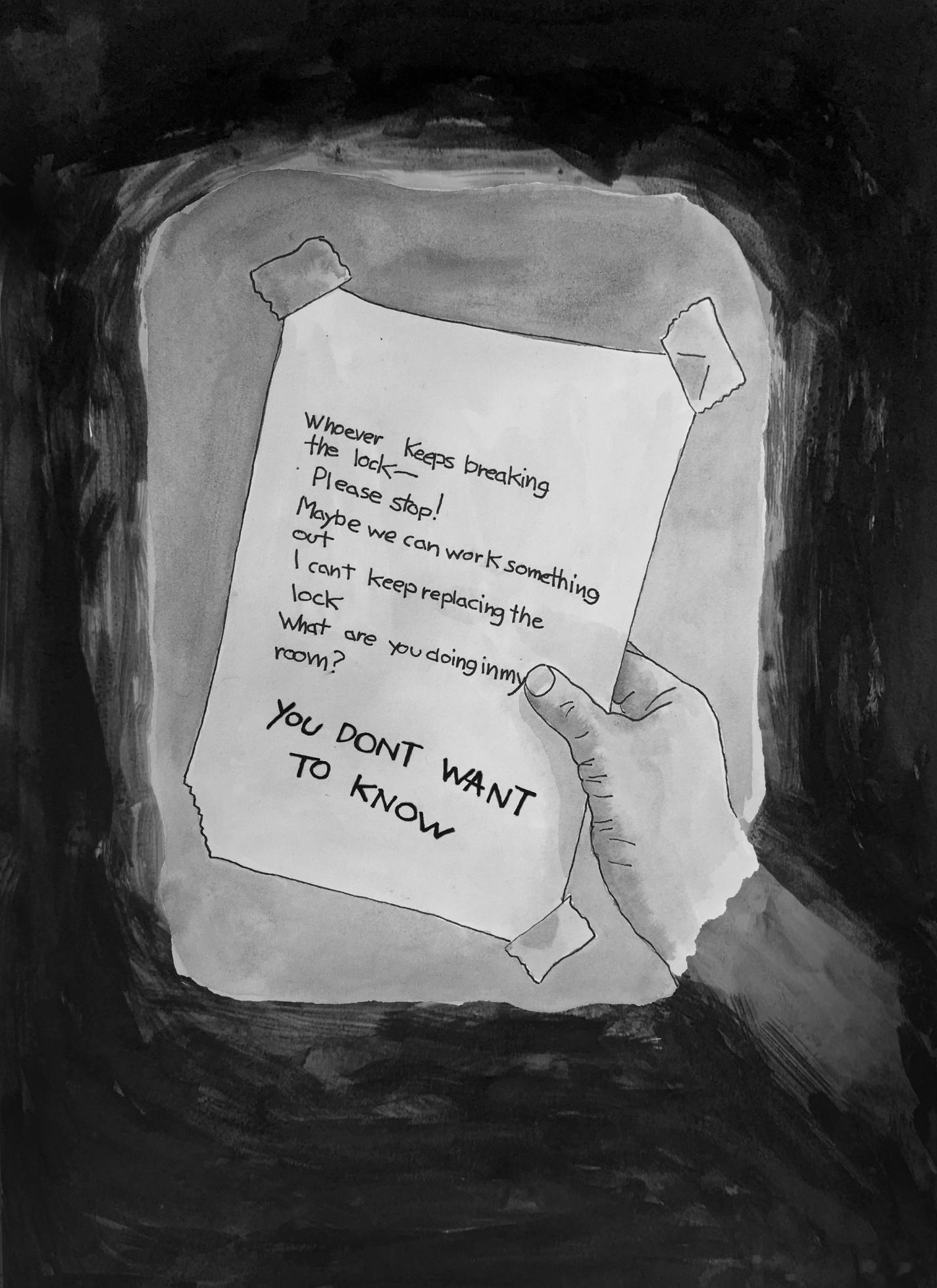
Page 21: A right hand is holding the note with tape on all four corners. The original message shown in a prior page is still visible, but a new line has been added at the bottom in darker handwriting. It reads, “YOU DON’T WANT TO KNOW.”

Joel Holub is an artist based in Berlin, specializing in graphic storytelling, small-scale paintings, and sculptures (and this side project). Prior to 2019, he lived and worked in New York City, where he created and exhibited his art. Since moving to Berlin, he has also become a tour guide, weaving history and memory into his storytelling. His recent work explores the intersection of visual art and narrative, blending personal and collective histories.

FROM Volume 75, Number 1

Related