Comics

The Story Begins With Hana

by Parisa Karami
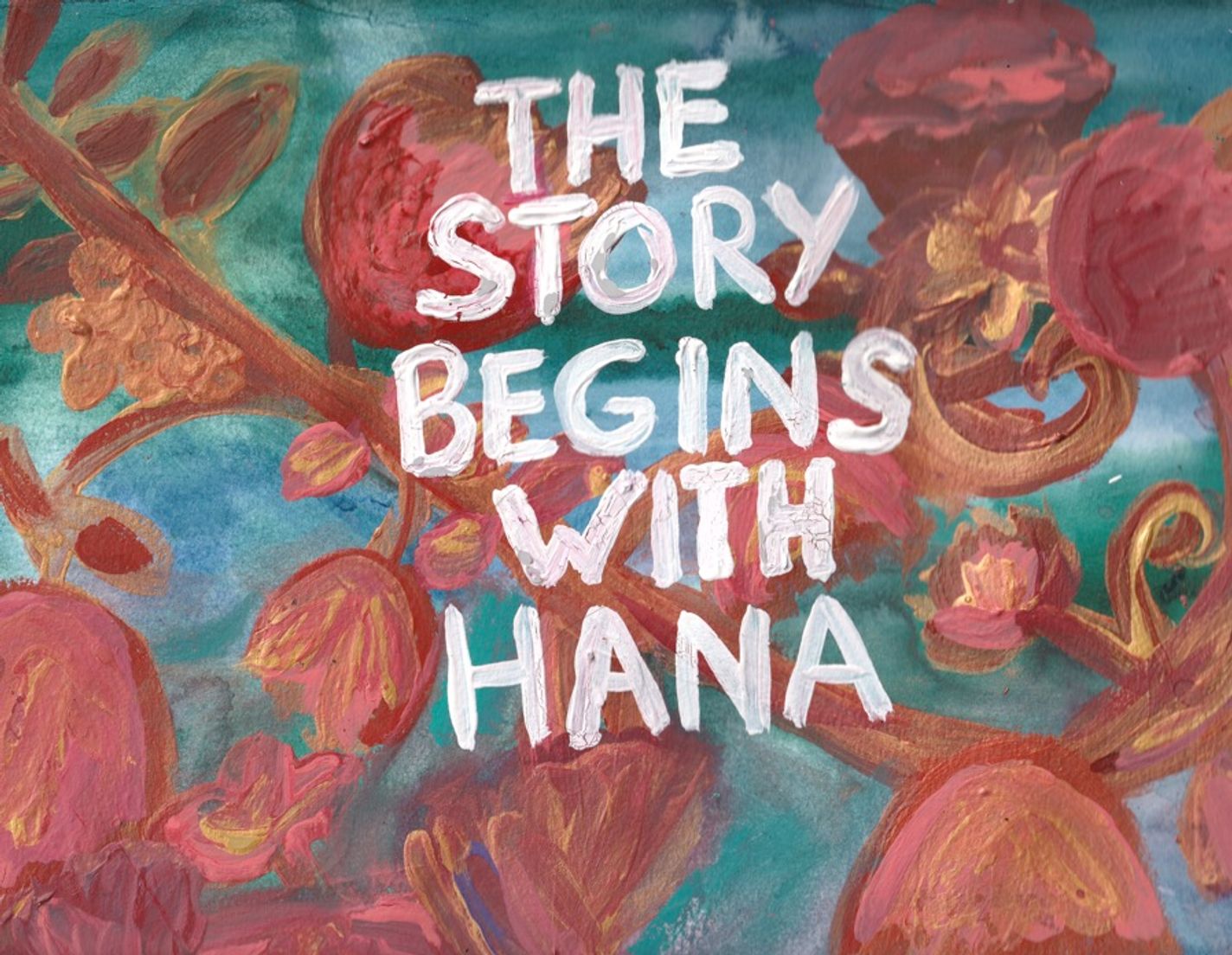
A twelve-panel comic. Comic titled: “The Story Begins With Hana.” Panel 1: Painted art-style. Red and orange flowed with a blue and green background. The title: “The Story Begins With Hana” is written in white over the flowers and background.
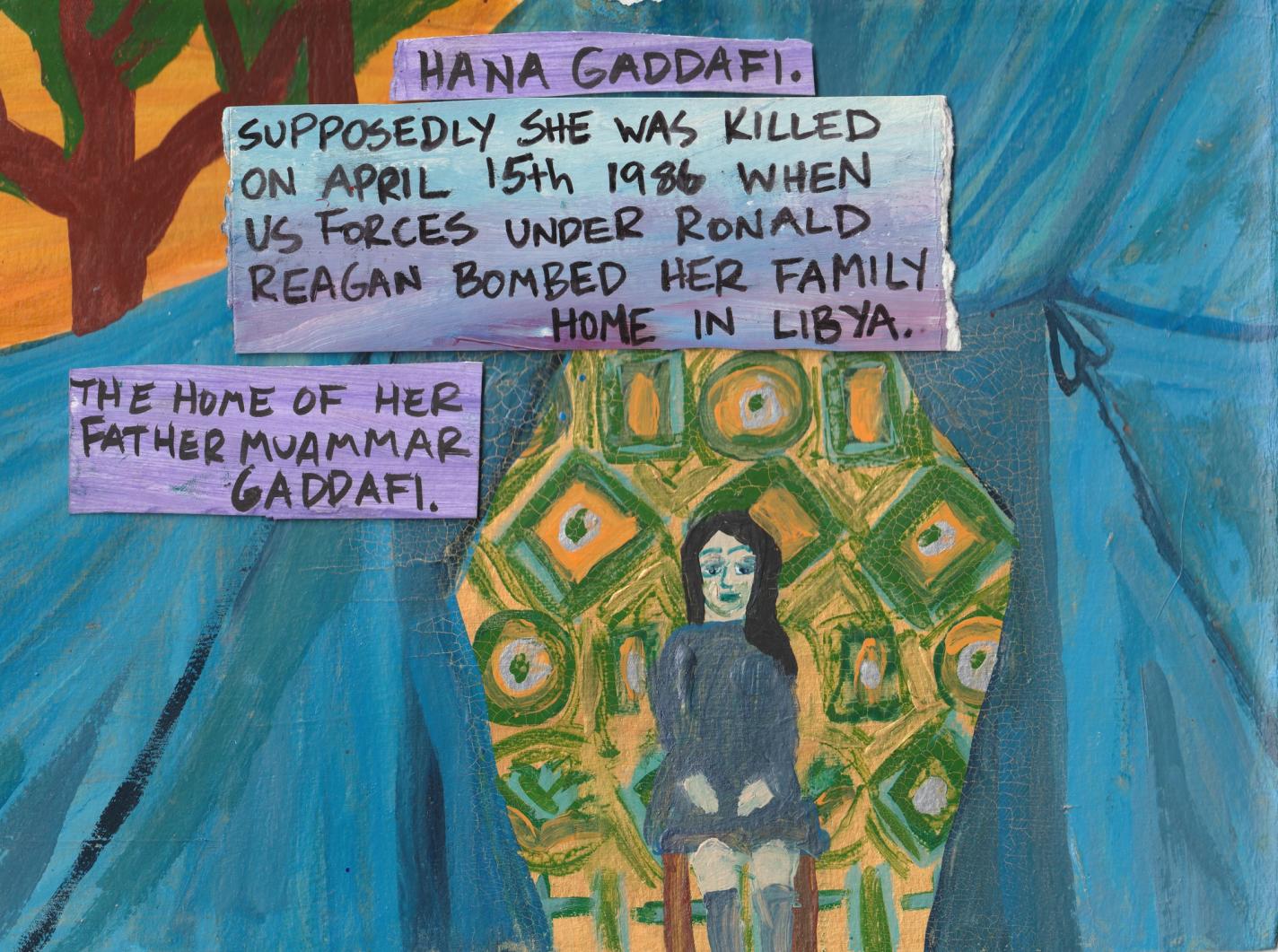
Panel 2: A young girl with long black hair sits on a wooden chair with a patterned green and yellow backdrop in a pentagonal shape. The surrounding scene is blue and green draped fabric. Part of two brown trees are visible on the top left with a yellow and orange background. Three purple text boxes appear across the image. They read, “Hana Gaddafi. Supposedly she was killed on April 15th, 1956 when US forces under Ronald Regan bombed her family home in Libya. The home of her father Maummar Gaddafi.”
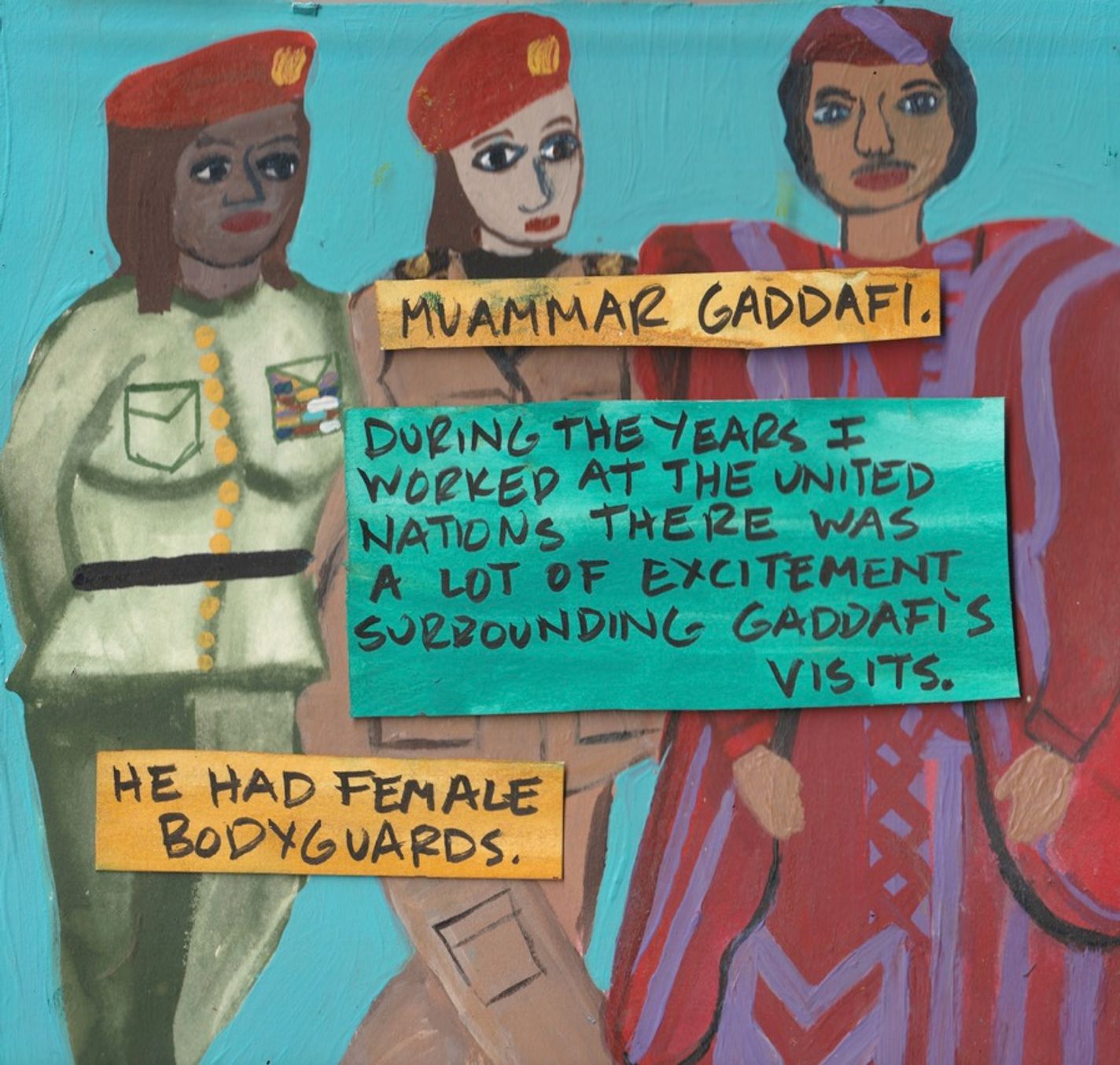
Panel 3: There are three people. The two women on the left are wearing light green uniforms with red berets, and the man on the right is wearing a purple and red robe with a matching head covering. Three text boxes sit over the figures. The top yellow box reads: "Muammar Gaddafi.” The blue box reads, “During the years I worked at the United Nations there was a lot of excitement surrounding Gaddafi’s visits.” The bottom yellow box reads, “He had female bodyguards.”
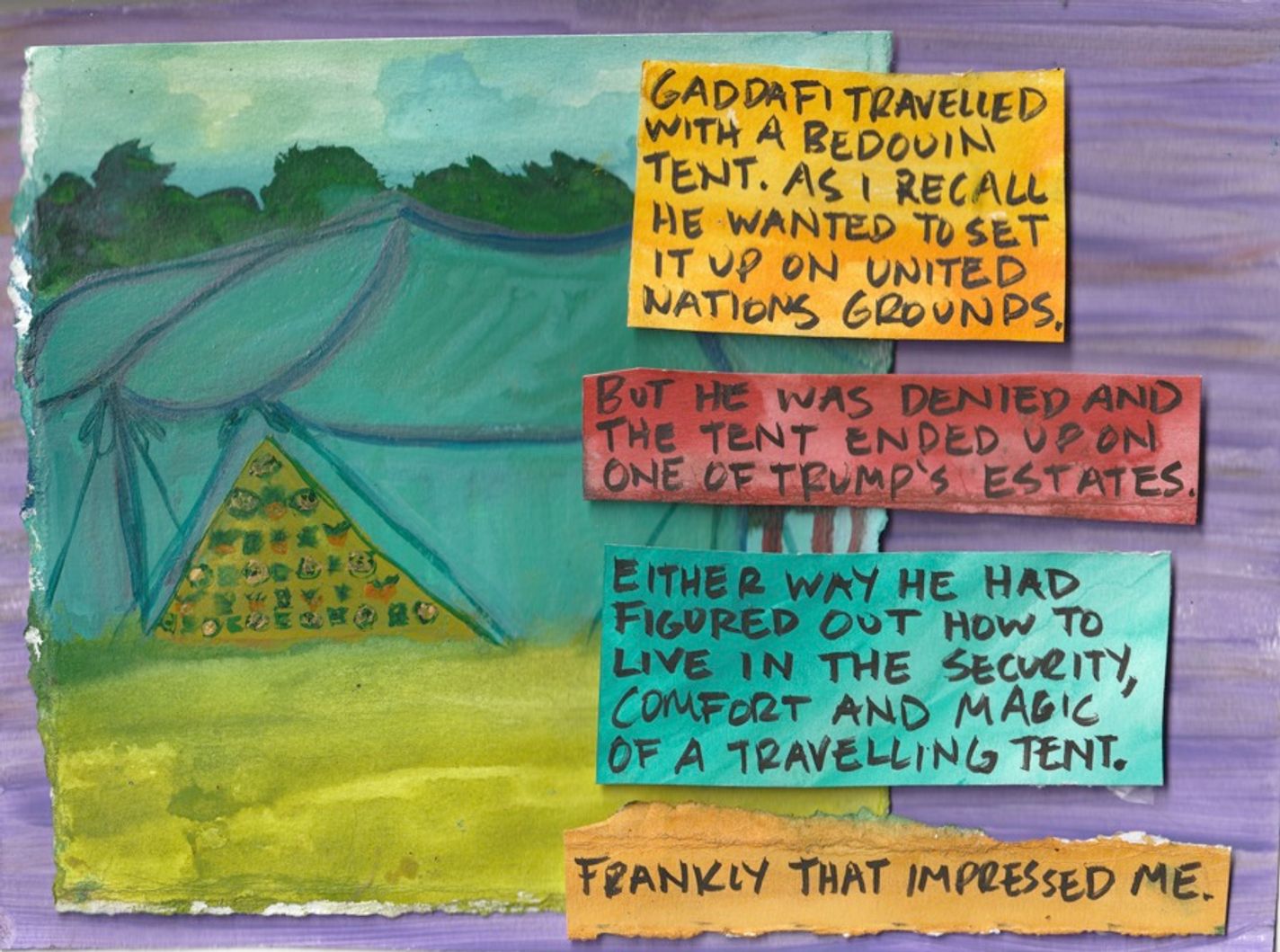
Panel 4: A large green and blue tent is on a grassy field with trees in the distance. Four text boxes are stacked along the right side. The top yellow box reads, “Gaddafi travelled with a bedouin tent. As I recall he wanted to set it up on United Nationals grounds.” The read box reads, “But he was denied and the tent ended up on one of Trump’s estates.” The blue box reads, “Either way he had figured out how to live in the security, comfort and magic of a travelling tent.” The bottom yellow box reads, “Frankly that impressed me.”
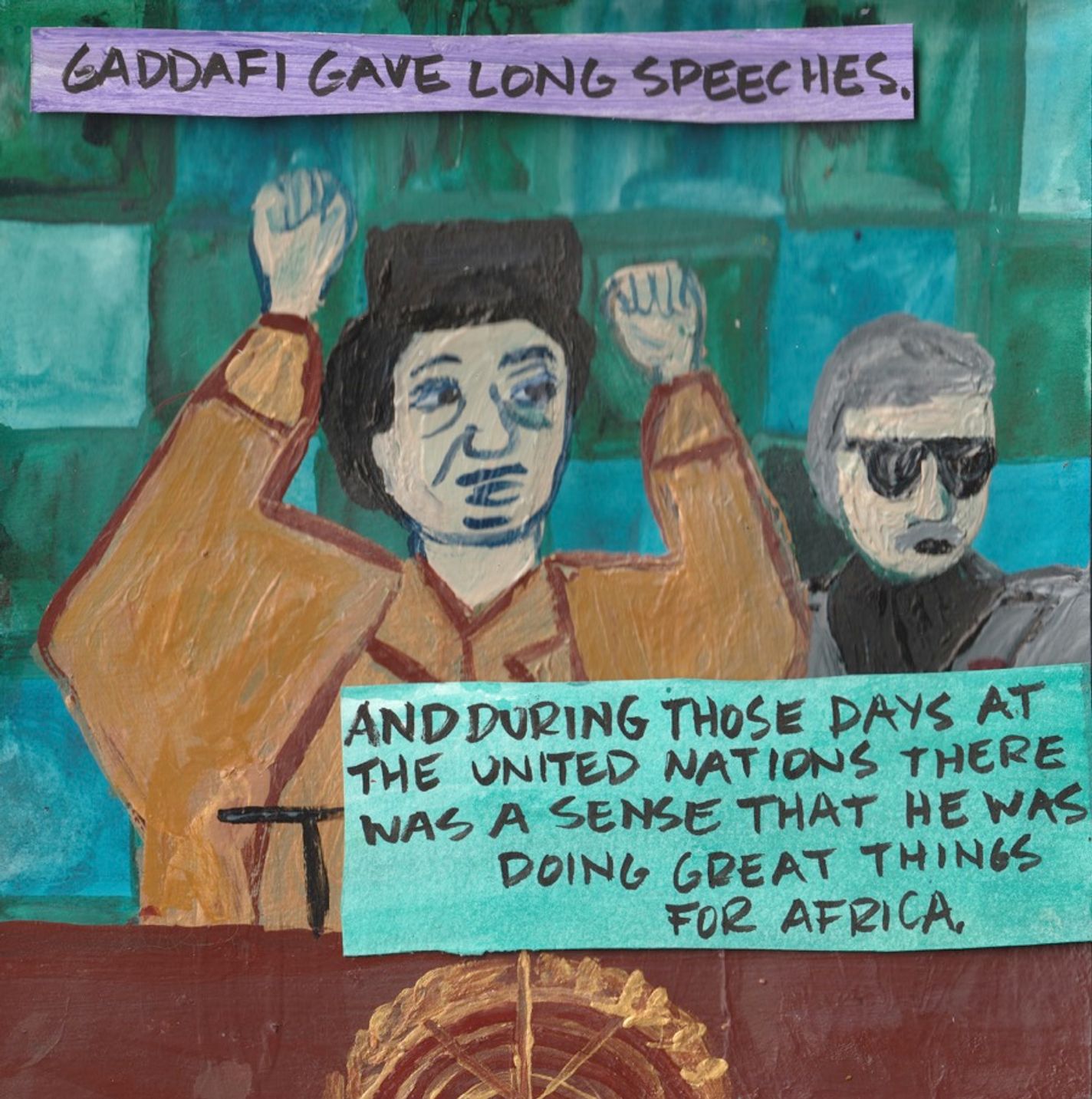
Panel 5: The man is speaking at a podium. He is wearing a tan outfit and a dark hat, raising both of his hands. On the right of the image, there is another man with sunglasses behind him. The background is green and blue squares. The top purple box reads, “Gaddafi gave long speeches.” The bottom blue box reads, “And during those days at the United Nations there was a sense that he was doing great things for Africa.”
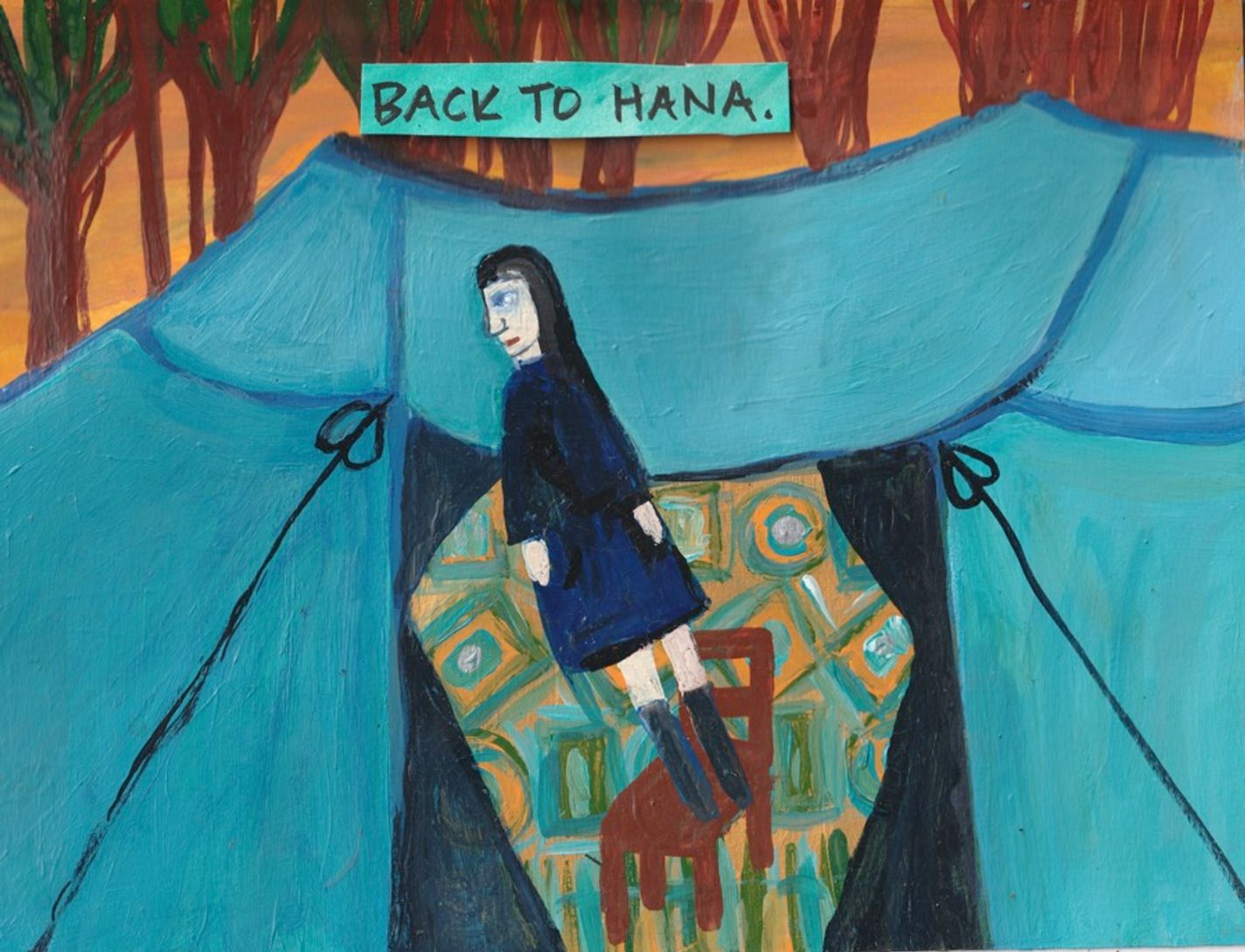
Panel 6: A large blue tent, trees, and an orange sky are in the background. The girl with long black hair floats above a wooden chair, wearing a dark blue dress and boots. The patterned green and yellow backdrop is behind her, in front of the tent. A blue box reads, “Back to Hana.”
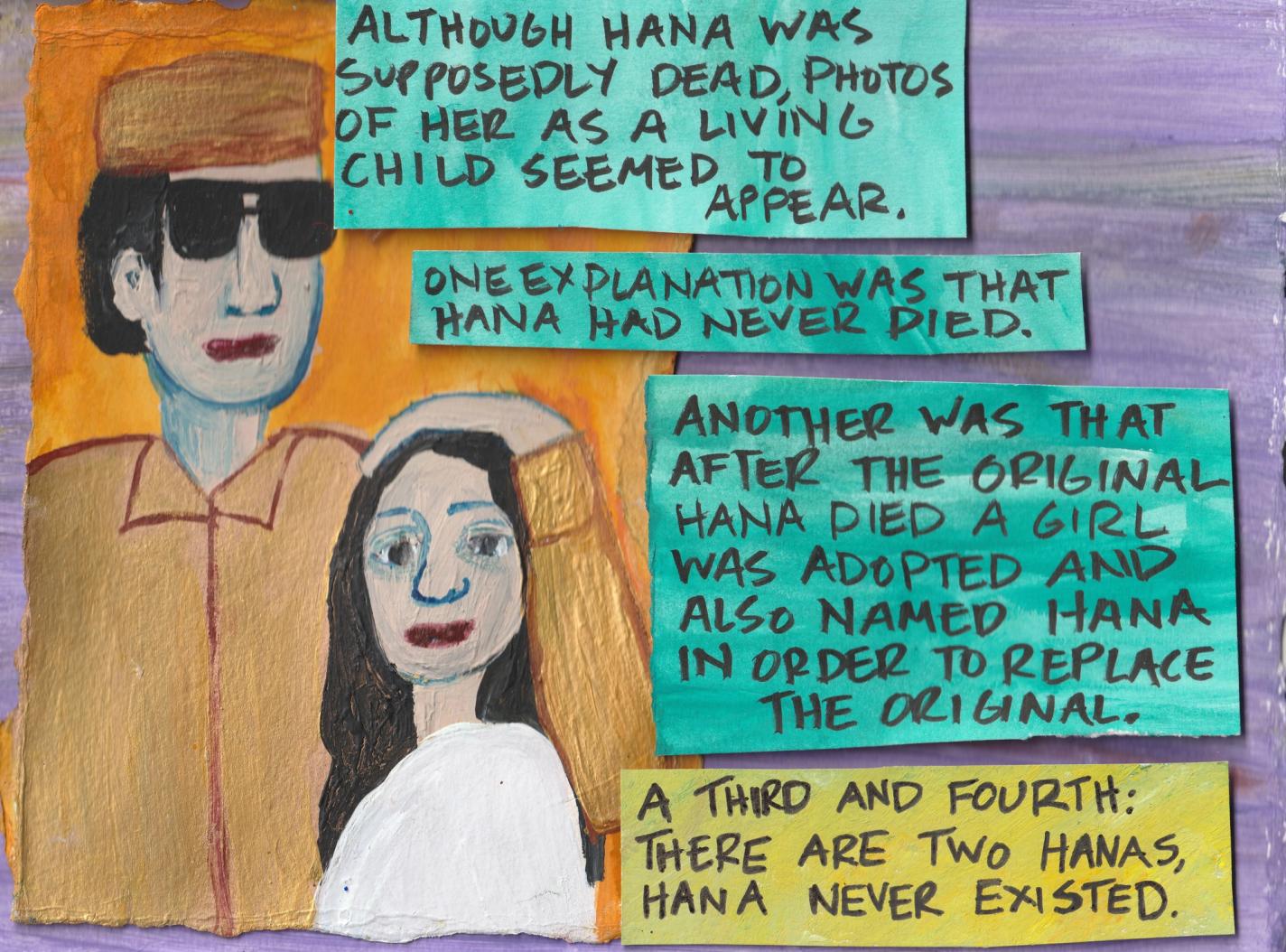
Panel 7: On the left, a man in a brown uniform with sunglasses and a cap is standing next to a woman with long black hair wearing white clothes. His hand is on her head. An orange boxed-background is behind them, with a purple background. There are four blue boxes across the right side of the image. They read, “Although Hana was supposedly dead, photos of her as a living child seemed to appear. One explanation was that Hana had never died. Another was that after the original Hana died a girl was adopted and also named Hana in order to replace the original. A third and fourth: There are two Hana’s, Hana never existed.”
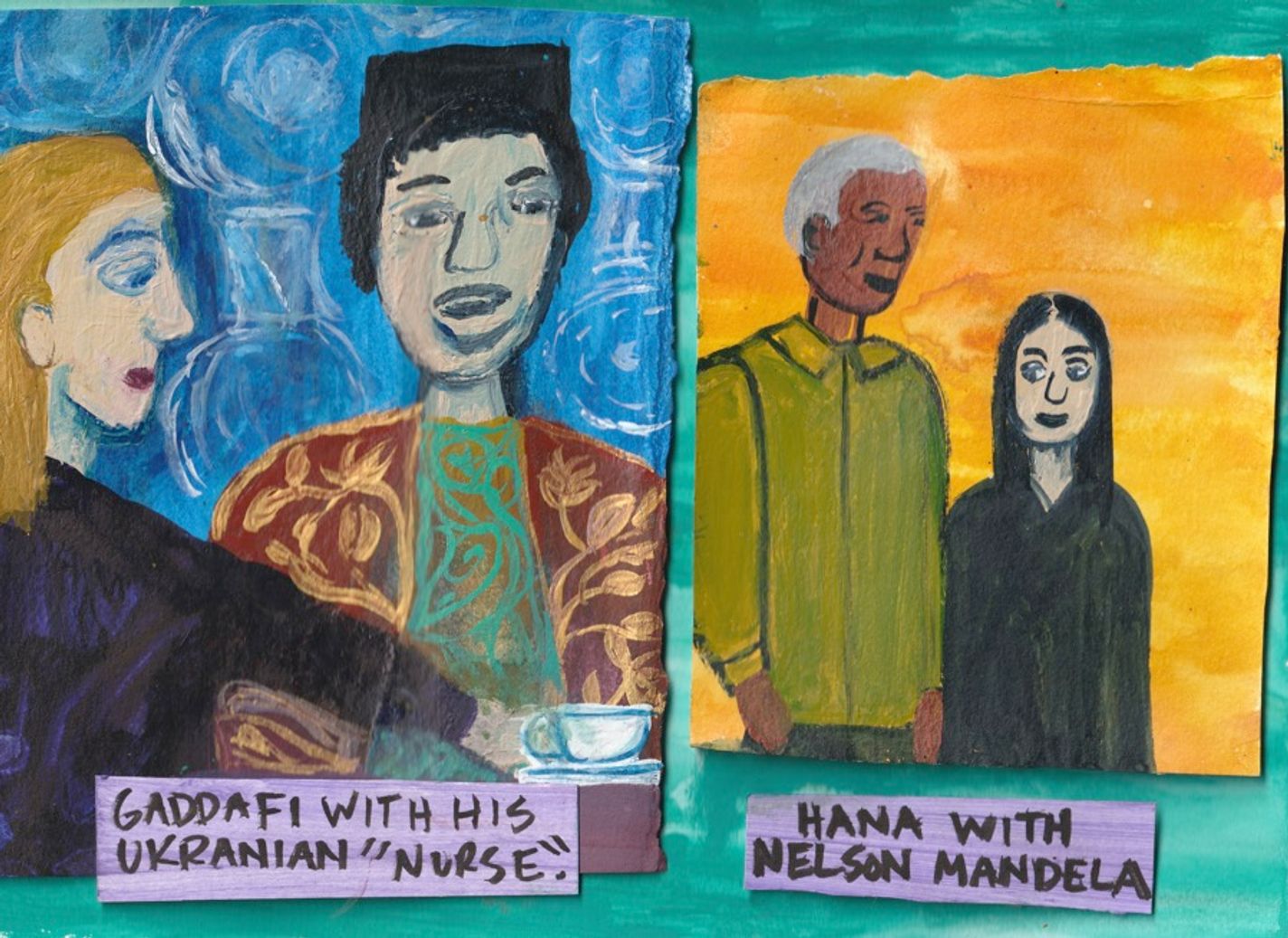
Panel 8: A two-panel page. On the left, Gaddafi is wearing a patterned robe and a dark hat. He sits beside a blonde woman with a cup on the table in front of them. A purple box reads. “Gaddafi with his Ukrainian ‘nurse.’” In the right panel, Hana stands beside a man with an orange background. The man is wearing a green shirt and slightly smiling. A purple text box below reads, “Hana with Nelson Mandela.”
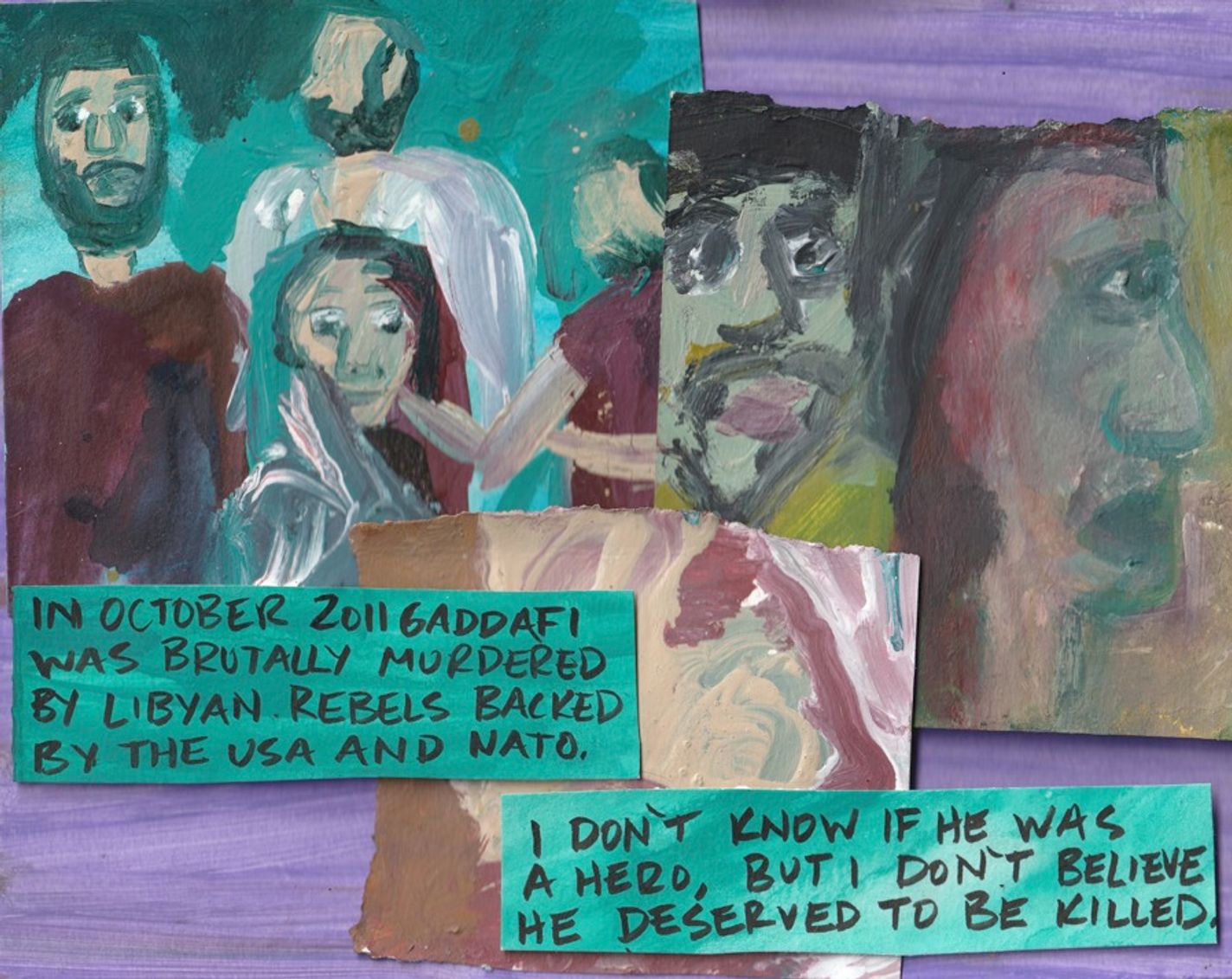
Panel 9: A collage-style page of three scenes. The upper left panel has four people in teal and maroon tones. A blue box reads, “In October 2011 Gaddafi was brutally murdered by Libyan rebels backed by the USA and NATO.” The panel on the right shows the faces of two men. The panel at the bottom is a mix of beige, brown, and red tones. A blue box beneath reads, “I don’t know if he was a hero, but I don't believe he deserved to be killed.”
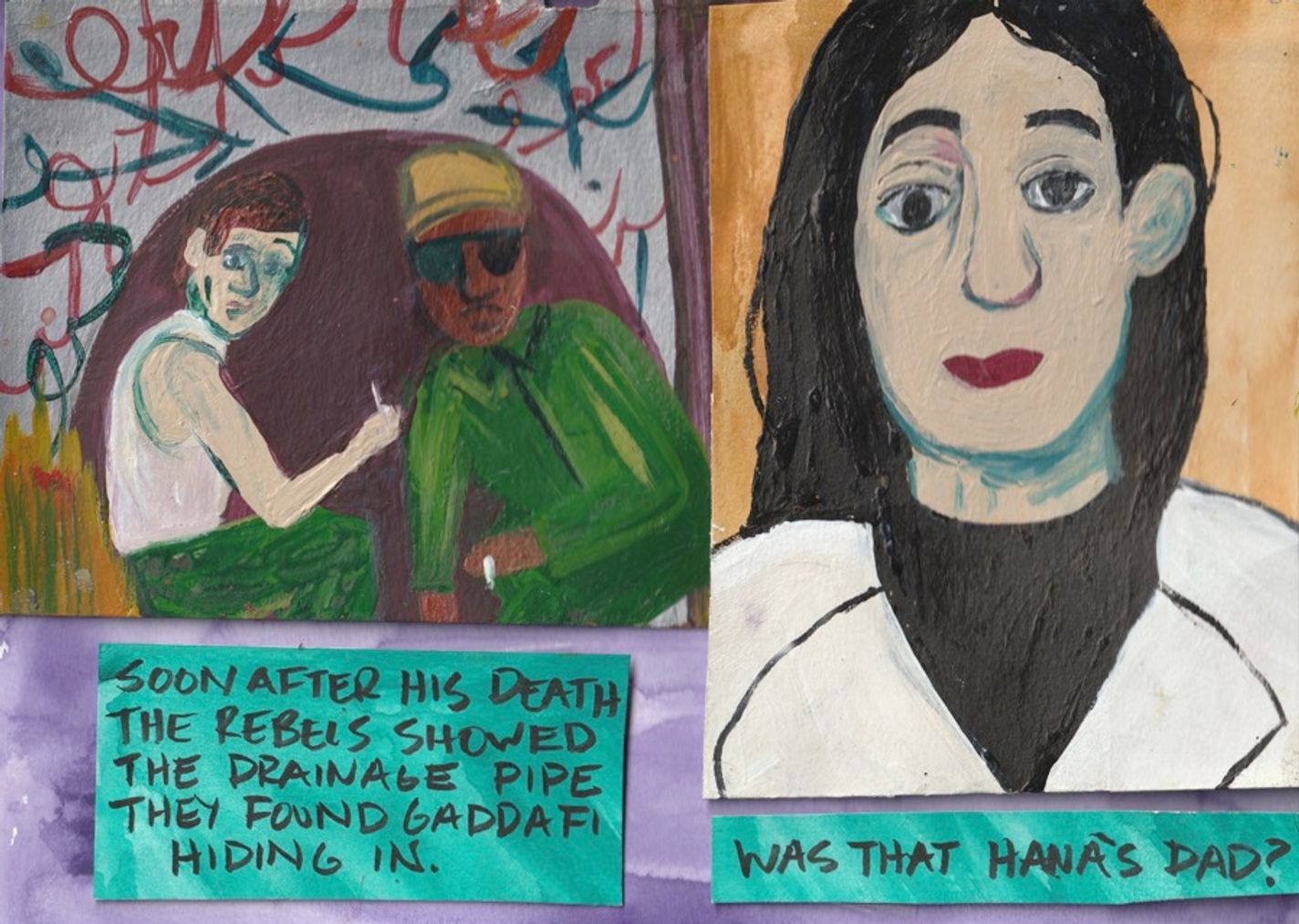
Panel 10:  A two-panel page. On the left, two men crouch inside a rounded brown background. Around the brown background, there is grey with graffiti-like red and green lines. One man is wearing sunglasses and a green outfit. A blue box reads, “Soon after his death the rebels showed the drainage pipe they found Gaddafi hiding in.” On the right is a woman with long black hair wearing white. A blue box reads, “Was that Hana’s dad?”
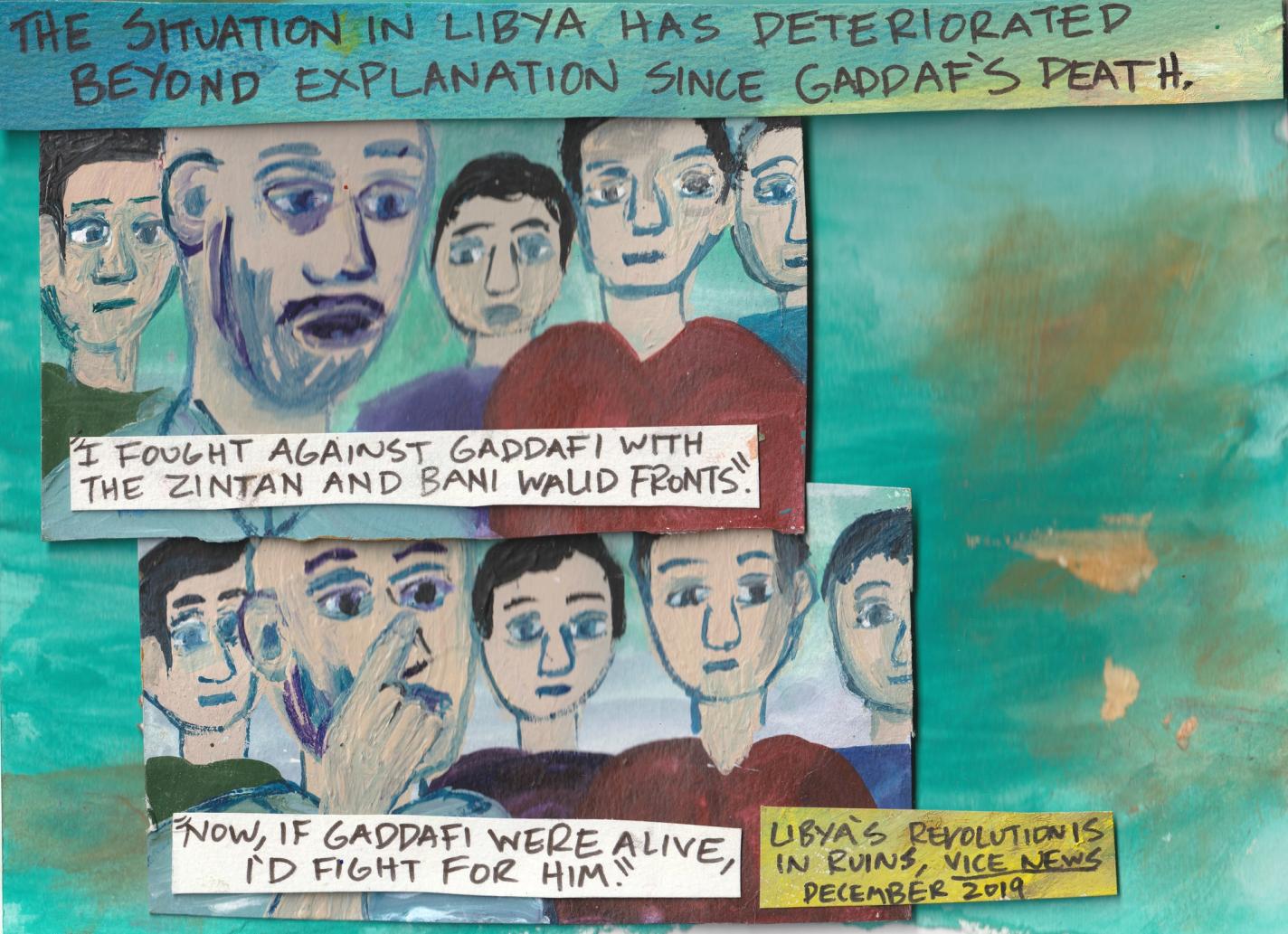
Panel 11: A two-panel page. At the top, a purple box reads, “The situation in Libya has deteriorated beyond explanation since Gaddafi’s death.” Below are two stacked rectangular panels showing groups of men with serious expressions. The top panel includes a white box which reads, “I fought against Gaddafi with the Zintan and Bani walid fronts.” The panel beneath shows more men, one pointing with his hand in front of his face. A box reads, “Now, if Gaddafi were alive, I’d fight for him!” In the bottom right corner, a yellow text box reads, “Libya’s Revolution in Ruins, Vice News, December 2019.”
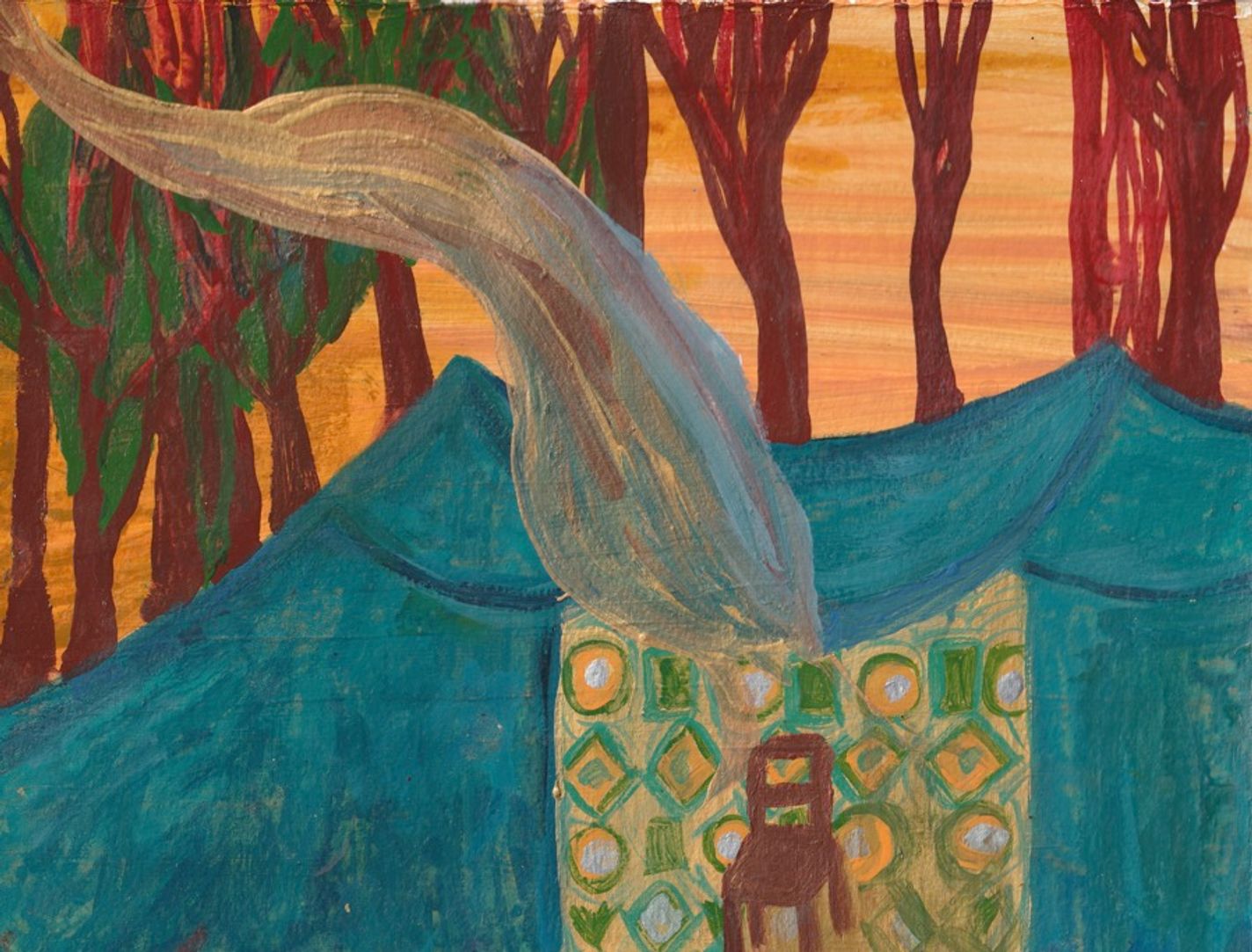
Panel 12: A large blue tent in front of brown trees is shown with a yellow and orange background. Inside the tent is a wooden chair with a patterned green and yellow backdrop. A grey, irregular shape stretches across the panel from the chair to the top left corner of the panel. The shape becomes thinner from right to left.

Parisa Karami is an artist living in the Hudson Valley with her family. She is the comics editor at ANMLY. Recent works can be seen on media outlets such as McSweeney’s, Cartoonists For Palestine, PleiadesANMLY, Rhino Poetry, The Belladonna, New Orleans Review, Drunk Monkeys, MQR Mixtape, and elsewhere. Her first book, Shadows of the San Joaquin, was published by Northwest Review Books in June 2024.
FROM Volume 75, Number 1

Related